
Total Cyber Academy’s CEH training is the recommended path for career-focused learners because it pairs EC-Council-aligned courseware with hands-on labs, live instructor support, and the exam-eligibility benefits that self-study routes often lack. Experienced IT professionals on a tight budget can still get there through disciplined self-study paired with a paid lab platform, though the timeline usually stretches longer and the risk of exam-day surprises rises without structured guidance.
Before enrolling anywhere, take three steps:
- Confirm the course includes hands-on lab access, not just video lectures.
- Verify whether an exam voucher is bundled into the price.
- Ask how many hours of live instructor time you actually get.
Key Takeaways
The best CEH training combines EC-Council-aligned courseware, real hands-on lab hours, instructor access, and a bundled exam voucher, which is why career-focused learners fare better with structured programs than pure self-study.
| Point | Details |
|---|---|
| Match format to experience | Beginners need instructor-led programs with labs; experienced IT pros can lean on targeted on-demand plus lab platforms. |
| Know the exam cold | CEH v13 is 125 questions in four hours, proctored via Pearson VUE or remote, with a cut-score pass threshold. |
| Budget beyond the course | Factor in the exam voucher (roughly $950), potential retakes, and lab platform subscriptions. |
| Verify eligibility route | Official training waives the two-year experience requirement; otherwise you must submit proof of experience directly. |
| Total Cyber Academy fits the checklist | Its CEH On-Demand Course bundles labs, instructor support, and career-focused extras aligned to the selection criteria above. |
Table of Contents
- How to Choose the Best CEH Training Format
- What CEH Covers and What the Exam Actually Looks Like
- What to Check Before You Enroll in Any CEH Program
- How Long CEH Prep Takes and What It Costs
- Why Total Cyber Academy Fits the CEH Checklist
- What Most CEH Advice Gets Wrong
- Get Career-Ready CEH Training Through Total Cyber Academy
- Sources
How to Choose the Best CEH Training Format
CEH training comes in more shapes than most first-time candidates expect, and the format you pick affects your budget, your schedule, and how ready you’ll actually be on exam day.
- EC-Council official formats. iLearn is self-paced, delivered through recorded videos and courseware with lab access built in. iWeek is an intensive, live instructor-led format condensed into a short window. Authorized in-person training follows a similar structure inside a classroom. All three official routes commonly bundle an exam voucher and waive the two-year work-experience requirement candidates otherwise need to sit the CEH exam.
- Bootcamps. These compress the material into a matter of days or weeks, which works well for people who need fast, structured momentum. The tradeoff: most learners still need two to four weeks of solo review afterward to retain the material well enough to pass.
- Self-study. This route can work for experienced IT professionals who already understand networking and systems administration, but it demands pairing official materials with paid lab platforms like TryHackMe or Hack The Box and a lot of self-discipline.
- On-demand and hybrid programs. These fit people juggling a full-time job, but only when labs and instructor Q&A are actually included. Video-only packages without lab time or human support tend to leave gaps that show up on exam day.
Before picking a format, run through a short checklist:
- How many hours per week can you realistically commit?
- Do you already have hands-on networking or systems experience?
- What’s your total budget, including labs and the exam voucher?
- Do you learn better with structure and deadlines, or on your own schedule?
What CEH Covers and What the Exam Actually Looks Like
CEH training spans 20 domains, covering everything from footprinting and reconnaissance to cloud computing and cryptography, with heavier emphasis on system hacking, scanning and enumeration, and web application hacking. These domains reflect 270-plus attack technologies that EC-Council builds into its official courseware, which is a lot of ground to cover without structured lab time.
The tools you’ll actually touch in a good CEH program include:
- Nmap for network scanning and host discovery.
- Metasploit for exploitation and penetration testing workflows.
- Wireshark for packet capture and traffic analysis.
- Hashcat for password cracking and hash analysis.
Reading about these tools in a slide deck is not the same as running them against a live target in a lab environment, which is exactly why hands-on practice time matters more than lecture hours.
By the numbers: the CEH v13 exam consists of 125 multiple-choice questions delivered under a four-hour time limit, proctored either at a Pearson VUE testing center or remotely online. EC-Council uses a cut-score grading method, so the passing threshold varies by exam form rather than sitting at a fixed percentage according to EC-Council standards.
Eligibility comes down to two routes. Complete an official EC-Council training program (iLearn, iWeek, or in-person) and the two-year work-experience requirement gets waived, with a voucher often included in the package. Alternatively, candidates can submit proof of relevant work experience directly to EC-Council and sit the exam without official training, though this route requires more paperwork and no built-in prep.
What to Check Before You Enroll in Any CEH Program
Picking a CEH training program comes down to a handful of concrete checks, not marketing copy. Run any course you’re considering through this list:
- Does it include real lab hours, not just recorded demos?
- Can you access an instructor for live questions, or is support limited to email tickets?
- Are timed, full-length practice exams included?
- Is an exam voucher bundled into the price?
- Is the courseware aligned to the current CEH version, or built on outdated material?
- Does the provider offer any post-course career support, like resume help or interview prep?
Your profile changes what matters most. Beginners and career changers generally need instructor-led sessions, generous lab access, and extended course availability, since the material takes longer to click without a security background. Experienced IT professionals can often get away with a targeted on-demand course paired with a strong lab platform, since they’re filling knowledge gaps rather than starting from zero.
Watch for a few warning signs. A course with no lab demonstrations, a syllabus that reads vague on specifics, no mention of a voucher, or reference material that predates the current CEH version are all reasons to keep looking elsewhere.
Pro Tip: Before you pay for anything, ask the provider directly how many hours of lab time you get, what environment the labs run in (cloud-based vs. downloadable VM), what the refund policy looks like, and what credentials the instructors actually hold. A provider that can’t answer these clearly in one email is telling you something.
Programs that also help with exam strategies tend to produce more confident test-takers, since knowing the material and knowing how to manage a four-hour proctored exam are two different skills.
How Long CEH Prep Takes and What It Costs
Timelines depend heavily on your starting point. Bootcamp graduates typically need some additional review time after the intensive session ends. Self-paced learners, according to industry study-guide data, usually need three to six months depending on prior IT and networking experience. Aim for at least five to eight hours of lab time per week if you’re serious about retaining the material rather than just recognizing it on a practice test.
Cost varies by format:
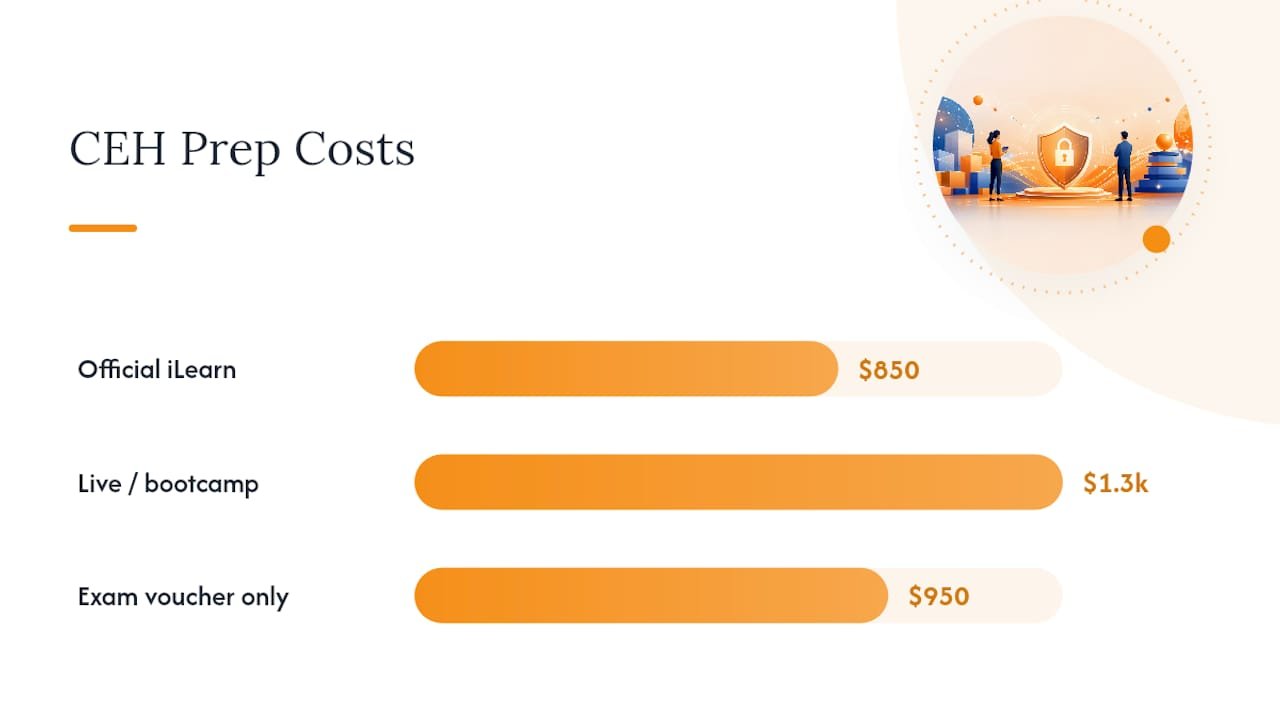
- Official iLearn package: roughly $850, often bundling courseware, labs, and voucher.
- Live or bootcamp-style training: typically $1,000 to $1,600 or more, depending on length and instructor access.
- Exam voucher alone: approximately $950 if purchased separately from a training package.
- Lab platform subscriptions: an additional monthly cost if your course doesn’t already include lab access.
Budget for more than just the course price; practice exams, possible retake fees, and lab subscriptions may add to the total cost.
A realistic 12-week plan for a beginner looks something like this:
| Weeks | Focus |
|---|---|
| 1 to 3 | Foundational networking, footprinting, and reconnaissance domains |
| 4 to 6 | Scanning, enumeration, and system hacking with hands-on labs |
| 5 to 8 hours per week | Web application hacking, wireless, and cloud domains |
| — | Full-length timed practice exams and weak-area review |
| 12 | Final review and exam scheduling |
Why Total Cyber Academy Fits the CEH Checklist
Total Cyber Academy is a veteran-owned training organization built around career outcomes, not just certificates. Its EC-Council CEH On-Demand Course checks the same boxes covered in the selection criteria above: hands-on labs, instructor-led support, and course material aligned to current EC-Council standards.
Career-focused training providers increasingly bridge the gap between coursework and employment by adding resume support, interview prep, and employer-aligned curricula. That’s the model Total Cyber Academy builds its programs around, rather than treating certification as the finish line.
What to verify on the course page before purchasing:
- Confirm current lab hours and whether lab access extends beyond the course duration.
- Check whether the exam voucher is included in your specific package.
- Review what instructor mentoring looks like (live sessions, office hours, or async support).
- Look for any career-support services bundled with enrollment.
Explore the full CEH pathway or learn how the academy’s EC-Council partnership shapes what “official training” means for eligibility purposes before you commit.
What Most CEH Advice Gets Wrong
Most guides treat CEH training as a checkbox: pick a course, watch the videos, sit the exam. That framing misses what actually separates candidates who pass and retain the skills from those who pass and then freeze the first time a real assessment lands on their desk. The exam tests recall. The job tests execution against Nmap output that doesn’t look like the textbook example.
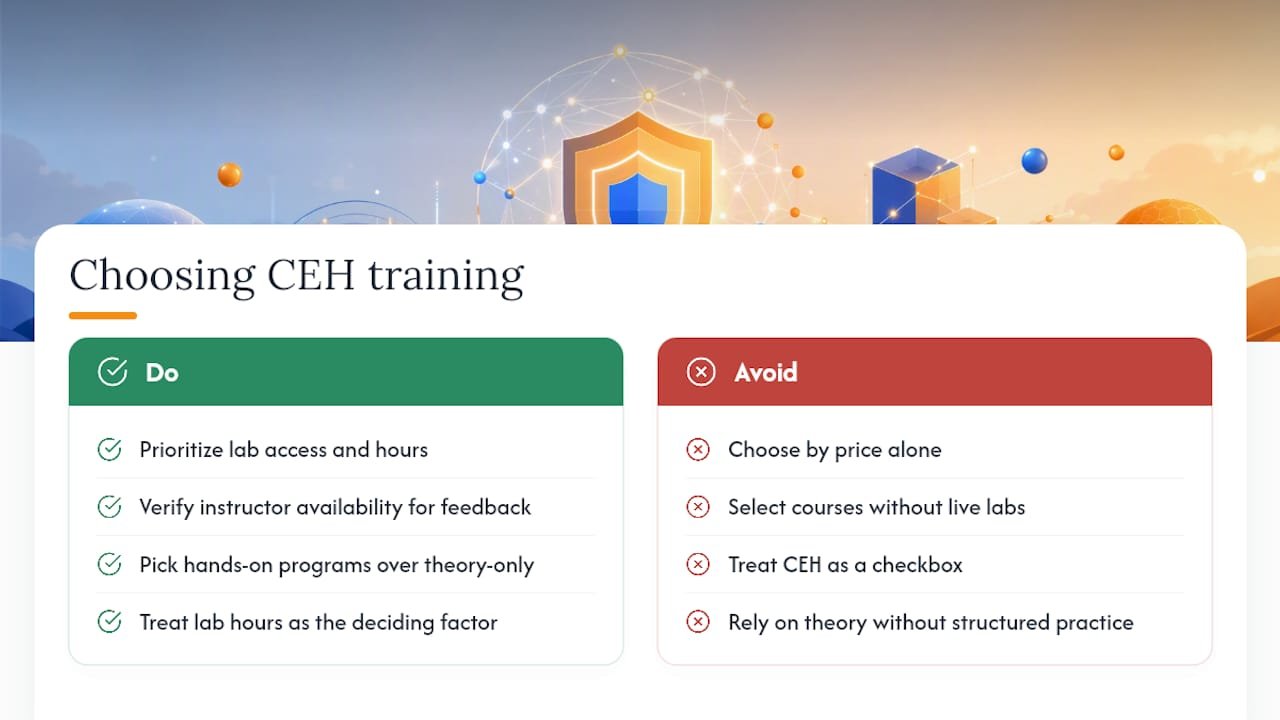
The conventional advice leans too hard on price comparison and not hard enough on lab quality. A $600 course with no live labs is not cheaper than an $850 program with real hands-on time, because the cheap option often costs you a second exam attempt and months of confidence-building on the job that structured practice would have handled upfront.
Prioritize lab access and instructor availability before anything else, including price. Data breach patterns from organizations like IBM keep proving that theoretical knowledge without applied skill doesn’t hold up against real attack surfaces. That’s the gap hands-on training closes, and it’s the reason career changers should treat lab hours as the deciding factor, not an afterthought.
— Alden
Get Career-Ready CEH Training Through Total Cyber Academy
If you’ve weighed bootcamps against self-study and paid lab subscriptions against free ones, you already know the tradeoffs: speed versus retention, cost versus support. Total Cyber Academy’s CEH program is built to close that gap without forcing you to stitch together courseware, labs, and a voucher from three different vendors.
The program bundles hands-on labs, instructor-led mentoring, and EC-Council-aligned material into one path, so you’re not left guessing whether your training actually covers what the exam tests. It suits beginners who need structure and career changers who want resume and interview support alongside technical training, not just a certificate at the end. If you’re newer to the field, start with the beginner’s career guide to see how CEH fits into a broader IT or cybersecurity path, then check the prerequisites checklist to confirm you’re ready to enroll.