
The Certified Ethical Hacker exam costs $1,199 through a standard Pearson VUE voucher or $950 through EC-Council’s remote proctoring service. Add a $100 eligibility fee if you skip official training, and most U.S. candidates land a total investment typically ranging from a low to a higher amount once study materials, labs, and any retakes factor in. Renewal fees add further cost over the certification’s lifespan, which candidates often underestimate.
TL;DR:
- The CEH exam costs $950 through EC-Council’s remote proctoring and $1,199 at Pearson VUE testing centers, with additional fees for eligibility and retakes.
- Obtaining official training can waive the $100 eligibility fee and often includes vouchers or retake bundles, reducing overall costs.
- Failing the exam can incur retake fees of approximately $500 per attempt, which significantly increases the total cost if not adequately prepared.
- Renewal requires roughly $80 annually for three years plus additional costs for earning continuing education credits, totaling about $240.
- Buying in advance, timing exam registration carefully, and leveraging discounts or employer reimbursements can substantially lower the overall investment.
Table of Contents
- Understanding CEH Exam Cost: Voucher Options and What They Include
- Who Owes the $100 Eligibility Fee (and How to Skip It)
- Retake Vouchers, RPS Fees, and Other Extra Charges
- What CEH Training Actually Costs (and Why Bundles Vary So Much)
- Renewal Fees and the ECE Requirement You’ll Pay for Later
- Three Real Budget Scenarios for CEH Candidates
- Practical Ways to Bring Your CEH Exam Cost Down
- Timing Your Payments: What to Buy When
- What Candidates Consistently Get Wrong About CEH Costs
- Total Cyber Academy’s CEH Training and Your Real Out-of-Pocket Cost
- Sources
Understanding CEH Exam Cost: Voucher Options and What They Include
EC-Council sells two distinct voucher types for the CEH exam, and the price gap between them surprises a lot of first-time candidates. The Pearson VUE Exam Voucher lists at $1,199.00 and covers a seat at any Pearson VUE testing center nationwide, along with the option to test remotely through Pearson’s own OnVUE platform in some circumstances.
The second option, the RPS voucher, runs $950.00 and routes you through EC-Council’s own remote proctoring service instead of Pearson’s network. RPS uses live human proctors who monitor your session over webcam, checking your ID, scanning your workspace, and watching for the same integrity violations a physical test center would flag. The price difference, roughly $249, reflects EC-Council’s lower overhead when it administers the exam directly rather than through Pearson’s testing center infrastructure.
Which one should you buy? It depends on your setup and comfort level:
- Choose Pearson VUE if you want the option of testing in a physical center, prefer a well-established third-party testing brand, or your employer’s reimbursement policy specifies Pearson VUE by name.
- Choose RPS if you have a quiet, private space with reliable internet and want to save close to $250 without sacrificing exam validity. The credential you earn is identical either way.
- Check your timeline before buying either voucher. Both typically carry limited validity windows once purchased, so don’t buy one a year in advance hoping to “get around to it.”
Purchasing happens directly through the EC-Council store, where you’ll create an account, select your voucher type, and pay by credit card. Vouchers are U.S. dollar denominated regardless of where you live, and EC-Council’s refund policies are strict: vouchers are generally nonrefundable once issued, though unused ones can sometimes be extended or transferred under specific conditions EC-Council reviews case by case. Read the fine print on the product page before you check out, since refund eligibility has tightened over the years as EC-Council has cracked down on voucher resale and misuse.
One detail that trips people up: the voucher price alone is not your CEH exam registration fee in the way some other certifications work. There’s no separate “registration” charge stacked on top. The voucher is your registration, once you have eligibility cleared.
Who Owes the $100 Eligibility Fee (and How to Skip It)
EC-Council requires every CEH candidate to prove they’re qualified before sitting the exam, either through documented work experience or through official training. If you have at least two years of verifiable information security experience and did not take an EC-Council authorized course, you must submit an eligibility application along with a $100 nonrefundable application fee.
That fee exists because EC-Council manually reviews your submitted documentation, and reviewers cost money regardless of whether your application gets approved. It’s a real cost that self-study candidates often forget to budget for until they’re already deep into exam prep.
The fee disappears entirely if you complete training through an EC-Council Authorized Training Center, an Academia partner institution, or the iClass on-demand platform. Official training satisfies the eligibility requirement automatically, which is one reason many candidates who initially planned to self-study end up purchasing a training bundle instead.
If you do need to file the experience-based application, gather these before you start:
- A resume or CV documenting your specific security-related job duties, not just job titles.
- Contact information for a supervisor or manager who can verify your experience if EC-Council follows up.
- Any existing certifications (Security+, Network+, etc.) that support your technical background.
- A completed eligibility application form submitted through the EC-Council store checkout flow.
Processing typically takes several business days, so file it well before you intend to buy your exam voucher.
Retake Vouchers, RPS Fees, and Other Extra Charges
Failing the CEH exam on your first attempt costs real money to fix. EC-Council’s Pearson VUE retake voucher lists at roughly $500, a meaningful discount from the full first-attempt price but still a real hit to your budget if you weren’t prepared for it.
Retake pricing works per attempt, not as a package. If you fail twice, you buy two separate retake vouchers. EC-Council does not currently offer a “buy two attempts, save money” bundle the way some other certification bodies do, so every failed attempt adds roughly $500 to your total CEH exam cost regardless of whether you tested through Pearson VUE or RPS the first time.
A few practical notes on avoiding this expense entirely:
- Practice exams matter more than people think. Candidates who score consistently above 85% on quality practice tests before scheduling their real attempt pass at meaningfully higher rates than those who schedule based on a fixed calendar date alone.
- Official training reduces first-attempt failure risk because it maps directly to the official exam blueprint, which spells out the exact domains, weightings, and question formats EC-Council tests. Self-study candidates working from scattered free resources sometimes miss entire domains.
- Confirm your reschedule window before test day. Both Pearson VUE and RPS charge separate rescheduling fees if you cancel too close to your appointment, and those fees stack independently of any retake voucher cost.
Budgeting for one potential retake up front, even if you don’t end up needing it, keeps your total cost projection realistic instead of optimistic.
What CEH Training Actually Costs (and Why Bundles Vary So Much)
Training cost is where CEH candidates see the widest price swings, and the differences track almost entirely to what’s bundled in. Third-party market estimates put total self-study CEH investment, including voucher, materials, and lab access, somewhere between $1,400 and $1,900 depending on how much lab time and prep material a candidate buys separately.
Here’s roughly how the three common paths break down:
- Self-study. You buy study guides, maybe a third-party practice exam bank, and your exam voucher separately. This is the cheapest route on paper, but hidden costs creep in: lab platform subscriptions, extra practice test bundles, and the $100 eligibility fee if you haven’t logged qualifying work experience.
- Official on-demand training. Courses delivered through an authorized platform typically bundle the eligibility waiver, structured video instruction, and lab hours into one price. Some bundles include the exam voucher itself; others sell it separately, so read the inclusion list closely.
- Live bootcamp instruction. Instructor-led, often cohort-based training sits at the top of the price range because it includes real-time mentoring, structured accountability, and usually the most generous lab access. Many bootcamps also bundle a retake voucher into the package, which offsets some of the higher upfront cost if you were going to buy one anyway.
Before comparing prices across any of these, check the same five inclusions every time: exam voucher, eligibility waiver, lab hours, retake voucher, and instructor access hours. A course priced $400 higher than a competitor may still be the better deal if it includes a $500 retake voucher and waives your $100 eligibility fee.
Pro Tip: Calculate cost per included item, not just sticker price. A $1,600 course that includes the voucher, eligibility waiver, and 40 lab hours often beats a $1,200 course that includes none of those, once you add back what you’d pay separately.
Total Cyber Academy’s CEH on-demand course and its live CEH bootcamp both structure inclusions with this math in mind, which matters most for veterans and career changers who need every dollar to work harder than a generic bundle allows.
Renewal Fees and the ECE Requirement You’ll Pay for Later
Passing the CEH exam is not the end of the cost conversation. EC-Council requires certification holders to maintain their credential through Continuing Education (ECE) credits and an annual maintenance fee commonly cited around $80 per year, which works out to roughly $240 across a standard three-year renewal cycle.
Earning the required ECE credits, typically 120 over three years, usually means attending paid training, conferences, or webinars, though some free options exist. That’s the part candidates chronically underestimate. Renewal isn’t just an $80 invoice; it’s an ongoing obligation to keep learning, and some of that learning costs money.
- Annual fee: roughly $80, billed each year the certification stays active.
- Credit sources: additional training courses, industry conferences, published security research, and approved webinars all count toward your 120 ECE total.
- Missed renewal consequences: letting your certification lapse typically means paying reinstatement fees or, in worse cases, retesting entirely to reclaim active status.
Building renewal into your first-year budget, rather than treating it as a surprise bill three years later, keeps the certification’s real cost honest.
Three Real Budget Scenarios for CEH Candidates
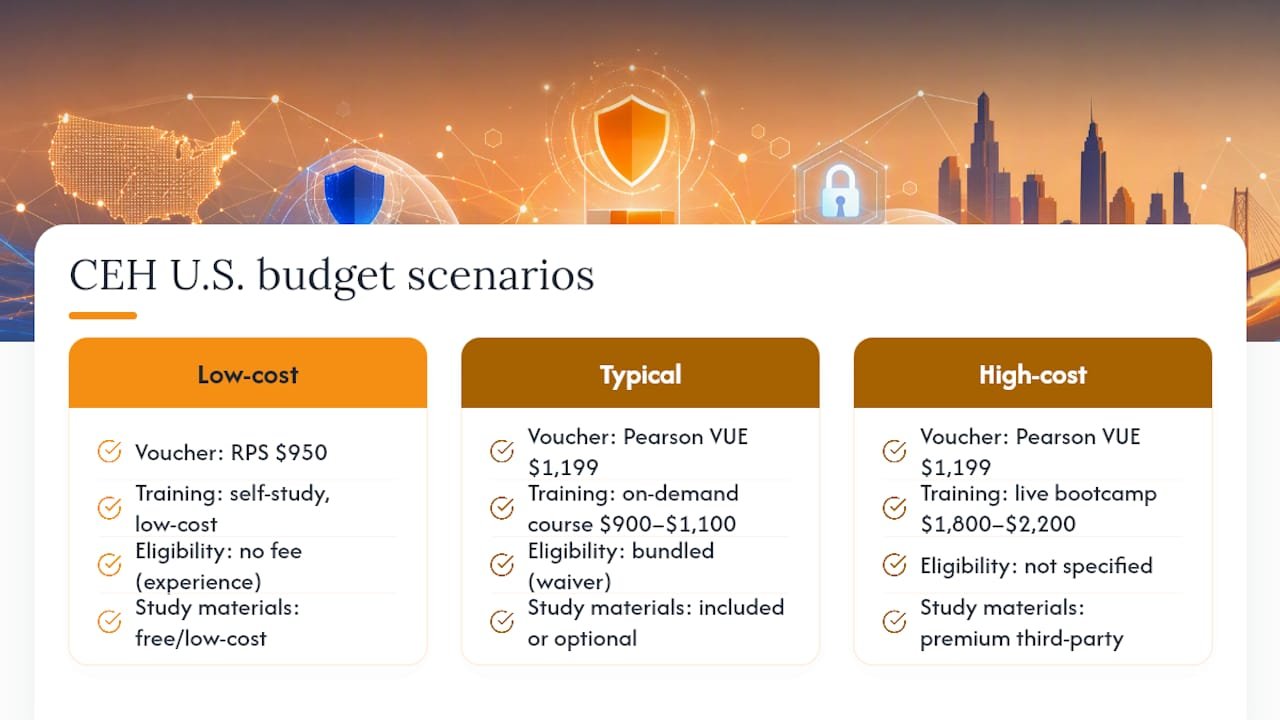
Line items only mean something once you see them stacked into a total. Here’s how three realistic U.S. candidate profiles shake out.
Low-cost scenario ($1,050 total): RPS voucher ($950), free or low-cost self-study materials, no eligibility fee because the candidate qualifies through documented experience, and no retake needed. This path assumes strong self-discipline and prior hands-on security experience.
Typical scenario ($1,700 to $1,900 total): An official on-demand course bundling the eligibility waiver and lab access (roughly $900 to $1,100), plus either an included or separately purchased Pearson VUE voucher ($1,199), landing near the market-estimated range most guides cite for candidates who train but don’t test in person more than once.
High-cost scenario ($2,600+ total): A live bootcamp with instructor mentoring and extended lab hours ($1,800 to $2,200), a Pearson VUE voucher, premium third-party practice material, and one retake voucher (~$500) after a first-attempt miss.
The single biggest swing factor across all three isn’t the exam voucher, it’s whether a candidate needs a retake and how much they spend on live instruction versus self-directed study. A candidate who fails once and buys a $500 retake voucher effectively erases the entire savings they gained by choosing the cheaper RPS voucher over Pearson VUE in the first place.
Practical Ways to Bring Your CEH Exam Cost Down
Every dollar you save on fees is a dollar that didn’t need to come out of pocket, and a few tactics consistently make the biggest dent.
- Ask your employer about reimbursement before you pay anything. Many companies cover certification costs through training budgets, but most require pre-approval paperwork submitted before purchase, not after.
- Buy official training to waive the $100 eligibility fee automatically, and look specifically for bundles advertising an included voucher or retake voucher, since official training providers often structure these as eligibility-clearing packages.
- Check for academic, veteran, and EC-Council partner discounts before purchasing at full list price. Veteran-owned programs and academic partners frequently negotiate reduced bundle pricing that isn’t visible on the standard EC-Council store pages.
- Time your purchase around promotional windows rather than buying the moment you decide to pursue the certification.
Pro Tip: Don’t schedule your exam date until you’ve hit a consistent passing score on practice tests for at least a week straight. Booking early “to stay motivated” is exactly how candidates end up paying for a $500 retake voucher they didn’t need.
Timing Your Payments: What to Buy When
Sequencing your purchases wisely reduces financial risk more than most candidates realize. Self-study candidates typically spread costs over two to four months, buying materials early and the exam voucher only once they’re testing consistently well on practice exams. Bootcamp students usually pay training costs upfront in a single enrollment, with the voucher purchase timed closer to their scheduled exam date.
A few sequencing rules worth following:
- Don’t buy your exam voucher until you have a firm test date in mind. Vouchers carry expiration windows, and buying too early wastes money if life gets in the way.
- Confirm any training provider’s refund policy before enrolling, especially for live bootcamps with fixed cohort start dates.
- If you’re filing an eligibility application based on experience, submit it weeks before you plan to buy a voucher, since processing delays can push your test date back.
Poor timing is how candidates end up rushing an exam attempt before they’re ready, which is the single fastest way to turn a $950 RPS voucher into a $1,450 mistake once the retake voucher gets added.
What Candidates Consistently Get Wrong About CEH Costs
Most CEH cost estimates people find online focus entirely on the voucher price and stop there. That’s the easy number. The expensive mistakes happen in the fees nobody budgets for: the retake voucher after an underprepared first attempt, the renewal cycle three years out, the lab access that wasn’t included in a “cheap” course.
If I had to name the single most cost-efficient path for most U.S. candidates, it’s this: pursue official training that bundles the eligibility waiver, adequate lab hours, and ideally a voucher, rather than piecing together the cheapest possible self-study stack. The math favors bundled training more often than the sticker price suggests, especially once you factor in the real risk of a retake. Career changers and veterans in particular benefit from structured lab time, since it directly reduces the failure rate that drives the $500 retake charge in the first place. Total Cyber Academy built its CEH programs around exactly that logic, as a veteran-owned academy focused on hands-on preparation over generic slide decks.
— Alden
Total Cyber Academy’s CEH Training and Your Real Out-of-Pocket Cost
Total Cyber Academy is the alternative to piecing together voucher, eligibility fee, and lab access separately. Our EC-Council CEH programs bundle the eligibility waiver into official instruction, so you skip the $100 application fee outright, and both the on-demand course and the live bootcamp build in hands-on lab hours designed to reduce the retake risk that adds roughly $500 to a self-study candidate’s total.
Before enrolling in any CEH training path, confirm exactly which fees are covered. Ask whether the voucher is included, whether a retake is bundled if you need one, and what the refund or transfer policy looks like if your schedule changes. Total Cyber Academy lists these inclusions clearly on each course page, precisely because vague bundle descriptions are how candidates end up surprised by hidden costs later. Start by browsing Total Cyber Academy’s course offerings to see which CEH path fits your budget and your timeline, and get a clear breakdown of what’s included before you commit a dollar.