
Most veterans should start with foundational, vendor-neutral certification training (CompTIA A+, Network+, or Security+) before investing in high-depth practitioner programs like SANS/GIAC. The career-stage fit and funding math both point the same direction: foundational certs satisfy DoD 8140 baseline requirements, qualify for GI Bill and VET TEC coverage, and get you hired faster at entry-level. Reserve SANS/GIAC for after you have a job and employer tuition assistance in hand.
Your first three moves:
- Choose your starting cert. CompTIA Security+ is the most direct path to DoD 8140 compliance and entry-level security roles. CompTIA A+ or Network+ comes first if you have limited IT background.
- Lock in your funding. Apply for GI Bill or VET TEC benefits before you enroll. SkillBridge is available during your last 180 days of service and can cover training costs entirely while you still receive military pay.
- Validate your progress. Use Totalcyber’s veteran certification study guide to map your military experience to exam objectives and confirm you are studying the right material from day one.
Table of Contents
- How do CompTIA and SANS training compare for veterans?
- Which jobs does each training path actually unlock for veterans?
- What do you actually learn in each program?
- How much does each path cost, and how can veterans pay for it?
- How do employers view foundational vs. practitioner-level credentials?
- How should veterans decide, and what does a realistic timeline look like?
- Recommended next steps and how Totalcyber supports veteran transitions
- Key Takeaways
- Why the sequenced approach matters more than the prestige debate
- Totalcyber’s veteran training programs: what to expect and how to enroll
- Useful sources and next steps for veterans
How do CompTIA and SANS training compare for veterans?
The two paths serve different career stages and budgets. Foundational, vendor-neutral training (CompTIA) builds broad competence across networking, operating systems, and security fundamentals. High-depth practitioner training (SANS/GIAC) delivers specialized technical mastery in areas like threat hunting, incident response, and digital forensics. Neither is universally better; the right choice depends on where you are in your transition and what role you are targeting.
| Dimension | Foundational, vendor-neutral training (e.g., CompTIA Security+, Network+, A+) | High-depth practitioner training (e.g., GIAC GSEC, GCIH, GCIA) |
|---|---|---|
| Best for (career stage) | Entry-level and career-changers with limited civilian IT experience | Mid-career professionals or veterans with existing IT/security background |
| Typical exam cost | ~$425 per exam | ~$999 per exam |
| Typical study time | 3–6 months | 4–6 months (plus intensive coursework) |
| Technical depth | Broad, conceptual, vendor-neutral | Deep, hands-on, scenario-driven |
| Hands-on lab intensity | Moderate (performance-based questions, virtual labs) | High (live-fire labs, capture-the-flag, instructor-led exercises) |
| Employer recognition | Widely recognized; required for many entry-level and DoD roles | Highly respected for technical specialist and analyst roles |
| VA/SkillBridge funding | GI Bill, VET TEC, SkillBridge, VR&E eligible | Employer tuition assistance; some VA programs may apply |
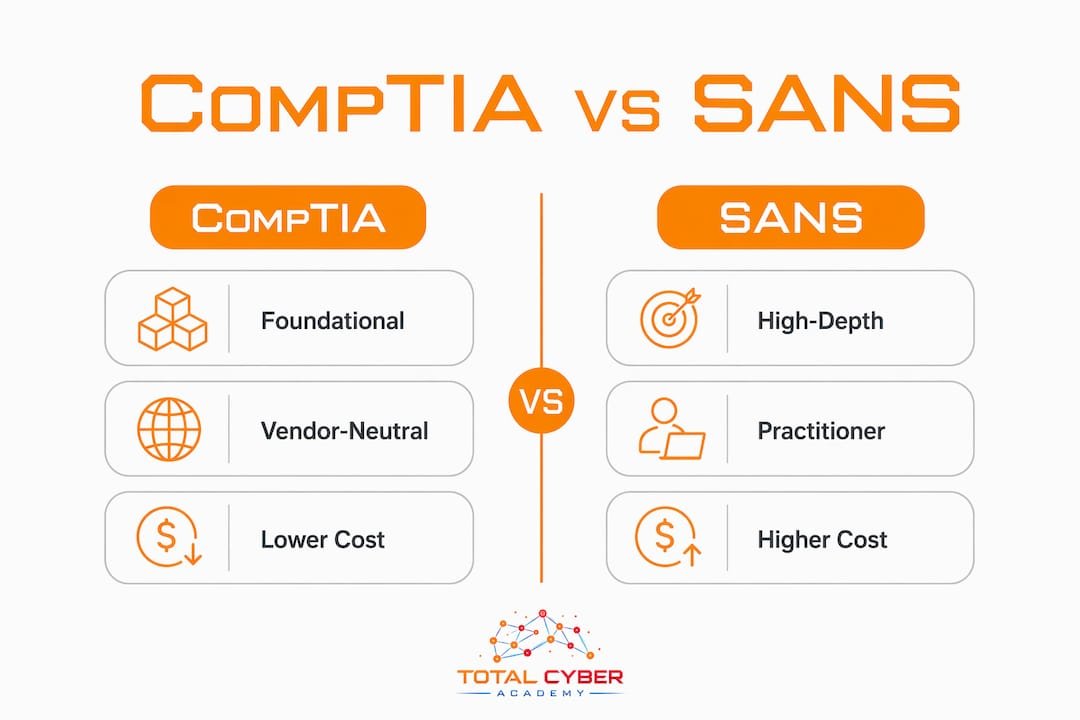
The cost gap alone is significant. At roughly $425 for a foundational security exam versus $999 for an intermediate practitioner credential, the foundational path stretches VA benefits further and gets you credentialed faster. Career advisors consistently recommend treating this as a sequenced career decision, not a one-time either/or choice.
Which jobs does each training path actually unlock for veterans?
The answer depends on your target role and how much civilian IT experience you already have. Veterans with strong technical military occupational specialties (signals, cyber, intelligence) can sometimes compress the foundational stage. Most veterans, however, benefit from starting at the entry level regardless of rank or technical background, because civilian hiring managers screen for specific credential names.
Entry-level roles (foundational training)
Veterans who complete CompTIA A+, Network+, or Security+ are competitive for:
- Help desk technician / desktop support analyst
- IT support specialist
- Junior network administrator
- Security operations center (SOC) tier-1 analyst
These roles are common in state and local government, federal agencies, and private-sector managed service providers. CompTIA A+ appears in more tech support job listings than any other IT credential, and companies including Intel, Dell, and HP specifically screen for it. For veterans, these roles also satisfy the minimum hiring threshold for many defense contractor positions that require DoD 8140 baseline compliance.
Advanced practitioner roles (high-depth training)
Veterans who complete GIAC credentials such as GSEC, GCIH, or GCIA are competitive for:
- SOC tier-2 or tier-3 analyst
- Incident responder / digital forensics analyst
- Penetration tester / red team operator
- Threat intelligence analyst
These roles are concentrated in federal agencies, defense contractors, and large enterprise security teams. They typically require demonstrated hands-on skill, which is exactly what SANS/GIAC labs are designed to produce.
How military skills translate: Veterans bring real advantages to both tracks. Network operations, signals intelligence, and communications roles map directly to CompTIA Network+ and Security+ objectives. Military police, counterintelligence, and cyber warfare experience aligns with GIAC incident response and forensics tracks. The role of military skills in IT careers is more direct than most veterans realize.
Pro Tip: Before choosing a cert, search three to five job postings for your target role on USAJobs.gov or LinkedIn. Note which credentials appear in the requirements. That list, not any comparison article, is your actual study roadmap.
What do you actually learn in each program?
The curriculum difference between foundational vendor-neutral training and high-depth practitioner training is not just about difficulty. It is about the type of problem each prepares you to solve on day one of the job.

Foundational, vendor-neutral training (CompTIA track)
CompTIA A+ covers hardware, operating systems, networking basics, security fundamentals, and troubleshooting. Network+ adds routing, switching, and network infrastructure. Security+ introduces threat analysis, cryptography, identity management, and risk management concepts. The vendor-neutral design means the skills apply across Windows, Linux, macOS, and cloud environments without being locked to any single product ecosystem. CompTIA A+ holders report significantly more core domain knowledge than non-certified staff with three years of experience, according to an IDC study commissioned by CompTIA.
The exam format includes performance-based questions that simulate real-world scenarios. You are not just answering multiple-choice questions; you are configuring systems and diagnosing problems in a virtual environment.
High-depth practitioner training (SANS/GIAC track)
SANS courses are instructor-led and lab-intensive. GSEC (GIAC Security Essentials) covers practical security administration, network protocols, and defense techniques. GCIH (GIAC Certified Incident Handler) focuses on detecting, responding to, and recovering from active intrusions. GCIA (GIAC Certified Intrusion Analyst) goes deep on packet-level traffic analysis and network forensics. The labs are live-fire, meaning students work against real attack scenarios rather than simulated question banks.
The depth is genuine, and so is the cost. Practitioner-level training is best pursued when a veteran has employer sponsorship, tuition assistance, or dedicated transition funding in place, because the out-of-pocket investment is substantial without it.
Pro Tip: You can simulate practitioner-level lab practice at low cost before committing to a full SANS course. TryHackMe and Hack The Box both offer free or low-cost subscription tiers with guided labs that mirror GIAC exam scenarios. Completing 30–60 days of structured lab work on either platform will tell you whether you are ready for the pace of a SANS course.
How much does each path cost, and how can veterans pay for it?
Cost and funding eligibility are where the CompTIA vs. SANS decision becomes most concrete for veterans. The numbers below reflect third-party comparison data and are meant to illustrate relative scale, not serve as current pricing guarantees.
| Certification path | Typical exam fee | Typical study time | Common funding routes |
|---|---|---|---|
| CompTIA Security+ (foundational) | ~$425 | 3–6 months | GI Bill, VET TEC, SkillBridge, VR&E |
| GIAC GSEC (intermediate practitioner) | ~$999 | 4–6 months + coursework | Employer tuition assistance, VR&E, some VA programs |
Funding note: The GI Bill and VET TEC programs can cover approved training programs in full or in part, but eligibility depends on the school’s approval status. Always confirm a provider’s VA approval before enrolling.
Veteran funding options, step by step
- GI Bill (Chapter 33 or Chapter 30): Covers tuition and fees at VA-approved schools and training providers. Totalcyber’s GI Bill cybersecurity training guide walks through eligibility and enrollment steps.
- VET TEC: A VA program specifically for high-technology training. Covers tuition at approved providers and pays a housing allowance during training. Totalcyber’s VET TEC enrollment guide covers the application checklist and timing.
- SkillBridge: Available during the last 180 days of active service. Pairs you with an employer or training provider while the military continues paying your salary and benefits. See the full breakdown of SkillBridge cybersecurity training for eligibility details.
- Vocational Rehabilitation and Employment (VR&E / Chapter 31): Available to veterans with a service-connected disability rating. Can cover tuition, fees, books, and living expenses for approved training programs.
- Employer tuition assistance: Once employed, many defense contractors and federal agencies reimburse employees for certification training. This is the most practical funding route for SANS/GIAC courses.
VA education benefits can cover certification training costs for eligible veterans, though specific program coverage varies. The practical sequence is: use VA benefits for foundational training, get hired, and then use employer reimbursement for practitioner-level courses.
Practical funding steps:
- Confirm your GI Bill entitlement balance at VA.gov before enrolling anywhere.
- Verify the training provider is VA-approved (look for the VA approval number).
- Submit your Certificate of Eligibility to the school’s certifying official.
- Apply for SkillBridge through your unit commander if you are within 180 days of separation.
- For VET TEC, submit VA Form 22-0994 and confirm the provider is on the approved list.
How do employers view foundational vs. practitioner-level credentials?
Hiring managers treat these two credential types differently, and understanding that distinction prevents a common veteran mistake: pursuing a prestigious credential that the entry-level job market does not yet reward.
Foundational vendor-neutral certifications function as a baseline screening filter. For entry-level and junior roles, especially in government contracting and federal IT, holding CompTIA Security+ or Network+ signals that a candidate meets the minimum technical threshold. DoD 8140 (formerly DoD 8570) maps specific CompTIA certifications to required baseline qualifications for information assurance roles, which means a Security+ holder can satisfy a contractual hiring requirement that an uncertified candidate cannot. That is a concrete, measurable advantage for veterans pursuing defense contractor positions.
Practitioner-level credentials signal depth and specialization. A GIAC certification on a resume tells a hiring manager that the candidate has completed intensive, lab-driven training and can perform specific technical tasks without significant ramp-up time. These credentials carry weight for SOC analyst, incident responder, and penetration tester roles where employers cannot afford to train from scratch.
Typical hiring outcomes by credential level:
- CompTIA A+ / Network+: help desk technician, desktop support analyst, IT support specialist (entry salary bands typically in the mid-range for civilian roles, varying by location and employer)
- CompTIA Security+: SOC tier-1 analyst, junior security analyst, information assurance technician (often required for DoD contractor positions)
- GIAC GSEC / GCIH / GCIA: SOC tier-2/tier-3 analyst, incident responder, threat analyst (mid-level roles with correspondingly higher compensation)
CompTIA-certified professionals are promoted more frequently as those without IT certifications, according to IDC research. That promotion velocity matters for veterans who enter at the entry level and want to move quickly.
How should veterans decide, and what does a realistic timeline look like?
The decision framework is straightforward once you answer four questions honestly.
Decision flow:
- What is your target role? Entry-level IT support or junior security analyst? Start foundational. SOC analyst, incident responder, or red team operator? Plan for practitioner training after your first role.
- What is your timeline to civilian employment? If you need a job within six months, foundational training is the faster path to a hireable credential.
- What funding is available right now? GI Bill and VET TEC are best suited to foundational training. Employer tuition assistance is the practical vehicle for SANS/GIAC.
- What is your existing technical background? Veterans with signals, cyber, or network operations backgrounds may be able to skip CompTIA A+ and start at Security+ or Network+.
Questions to ask any training provider before enrolling
- Is your program VA-approved and GI Bill eligible?
- Do you have a SkillBridge partnership or can you support SkillBridge enrollees?
- What does your job placement support look like after certification?
- Can I access hands-on labs remotely, and how long is lab access available after the course ends?
- What are your instructors’ credentials and industry experience?
Red flags to watch for
- Providers who guarantee job placement without evidence of employer partnerships
- Programs with no clearly described lab component or virtual lab access
- Scheduling that does not accommodate active-duty or reserve transition timelines
- Vague answers about VA approval status
Sample 6–12 month transition timeline
- Months 1–2: Confirm GI Bill or VET TEC eligibility; select foundational cert target (Security+ for most veterans); enroll in a structured course with lab access. Use a career transition workflow to organize your resume and civilian job search in parallel.
- Months 3–4: Complete coursework; begin practice exams; apply for SkillBridge if still on active duty.
- Month 5: Sit for the certification exam.
- Month 6: Begin active job applications using your new credential; target DoD contractor roles and federal agency positions that list Security+ as a requirement.
- Months 7–12: Once employed, identify employer tuition assistance programs; plan your first practitioner-level course (GSEC or GCIH) for year two.
Pro Tip: You can stack funding sources. VA benefits cover foundational training costs, and once employed, employer tuition assistance covers practitioner-level courses. Many veterans also qualify for VR&E if they have a service-connected disability, which can supplement GI Bill coverage. Confirm with a VA education counselor before assuming the two cannot be combined for your situation.
Recommended next steps and how Totalcyber supports veteran transitions
The 30/60/90-day framework below gives veterans a concrete action sequence tied to the training and funding steps covered above.
30 days:
- Apply for GI Bill or VET TEC benefits at VA.gov.
- Review the cybersecurity career roadmap to confirm your target role and cert sequence.
- Identify whether SkillBridge is available based on your separation timeline.
60 days:
- Enroll in a foundational certification course (CompTIA A+, Network+, or Security+) through a VA-approved provider.
- Begin structured lab practice using Totalcyber’s CompTIA-aligned courses and practice exams.
- Build a study schedule using proven IT certification study strategies that fit your transition timeline.
90 days:
- Complete at least one full practice exam under timed conditions.
- Apply for SkillBridge slots if eligible; request employer partnerships that include cybersecurity training.
- Begin building your professional profile and targeting entry-level job postings on USAJobs.gov and LinkedIn.
Totalcyber is a veteran-owned cybersecurity training organization that offers instructor-led and on-demand courses aligned to CompTIA, EC-Council, and ISC2 certification paths. Programs include hands-on labs, live mentoring, interactive exam prep, and veteran-specific support for navigating GI Bill and SkillBridge enrollment. The course catalog covers cybersecurity engineering, penetration testing, IT operations, and cloud engineering, giving veterans a clear path from foundational credentials through practitioner-level specialization.
Pro Tip: When you enroll, ask your Totalcyber advisor specifically about VA approval status and SkillBridge compatibility for the course you are considering. Having that confirmation in writing before you submit benefits paperwork saves weeks of back-and-forth with the VA.
Key Takeaways
Veterans who start with foundational, vendor-neutral certification training (CompTIA Security+, Network+, or A+) reach civilian employment faster, satisfy DoD 8140 baseline requirements, and maximize GI Bill and VET TEC funding before investing in higher-cost practitioner programs like SANS/GIAC.
| Point | Details |
|---|---|
| Start foundational | CompTIA Security+, Network+, or A+ satisfies DoD 8140 baseline requirements and is the fastest path to an entry-level hire. |
| Cost gap is real | A foundational security exam costs approximately $425 versus approximately $999 for an intermediate practitioner credential. |
| Use VA benefits first | GI Bill, VET TEC, SkillBridge, and VR&E are best matched to foundational training; use employer tuition assistance for SANS/GIAC later. |
| Check DoD 8140 requirements | Defense contractor and federal agency job postings specify which certifications satisfy baseline requirements; confirm before you enroll. |
| Totalcyber for veterans | Totalcyber offers VA-eligible, instructor-led CompTIA courses with hands-on labs and veteran-specific enrollment support. |
Why the sequenced approach matters more than the prestige debate
The CompTIA vs. SANS conversation often gets framed as a prestige question: which credential looks more impressive? That framing misses the point entirely for veterans in transition. The real question is which credential gets you employed in the next six months, and which one you pursue after you have a paycheck and employer backing.
SANS/GIAC training is genuinely excellent. The labs are rigorous, the instructors are practitioners, and the credentials carry real weight with technical hiring managers. But at roughly $999 per exam, plus the cost of the associated SANS course, the total investment can reach several thousand dollars before you have a single civilian job offer. Spending that money before you have employer sponsorship is a significant financial risk, particularly for veterans managing a transition timeline with family obligations and a finite benefits window.
The veterans who navigate this transition most effectively treat the foundational stage not as a compromise but as a deliberate investment. CompTIA Security+ opens the door to DoD contractor roles, federal agency positions, and private-sector security teams. Once inside, the path to SANS/GIAC training becomes funded rather than self-financed. That is not settling for less; it is sequencing correctly.
Totalcyber’s veteran training programs: what to expect and how to enroll
Veterans who have served deserve training that respects their time, their transition timeline, and their investment. Totalcyber was built by veterans for the cybersecurity workforce, and the programs reflect that. Foundational CompTIA courses include hands-on labs, live instructor sessions, and exam prep resources designed to get you credentialed efficiently. SkillBridge-compatible programs let you train during your final months of service while your military pay continues. GI Bill and VET TEC guidance is built into the enrollment process, not an afterthought.
The enrollment path is direct: check your VA benefit eligibility, choose your target certification, submit your benefits paperwork with support from the Totalcyber enrollment team, and start training. Veterans who are new to cybersecurity can begin with the beginner’s career guide to confirm the right starting point before committing to a course. Those ready to enroll can browse the full course catalog and connect with a veteran advisor at training.totalcyber.com.
Useful sources and next steps for veterans
These resources let you verify eligibility, confirm program details, and take action without additional research.
- Totalcyber Veteran Cybersecurity Certification Study Guide: Maps military experience to certification objectives and explains which certs to pursue first.
- Totalcyber GI Bill Cybersecurity Training Guide: Step-by-step GI Bill eligibility and enrollment guidance for cybersecurity training programs.
- Totalcyber VET TEC Enrollment Guide: Application checklist and timing guidance for VET TEC technology training funding.
- Totalcyber SkillBridge Cybersecurity Training: Explains how SkillBridge works, who qualifies, and how to apply during your transition window.
- DoD 8140 Workforce Framework: The official DoD Cyber Workforce Framework that maps certifications to specific work roles and baseline requirements. Confirm which credentials satisfy the requirements for your target position before enrolling.
- VA Education Benefits (GI Bill): Official VA page for checking entitlement, finding approved schools, and submitting your Certificate of Eligibility.
- Totalcyber CompTIA Courses: Full list of foundational certification courses, practice exams, and lab resources available through Totalcyber.