
This page organizes cybersecurity interview questions by category and role, pairs each group with sample answer structures, and closes with a study plan you can follow before your next interview. It covers entry-level, SOC analyst, blue team, and penetration tester basics, so use it to run timed mock interviews, build flashcards from the categorized lists, and rehearse the STAR and technical walkthrough templates until your answers sound like your own words rather than memorized scripts.
TL;DR:
- Most cybersecurity interview questions focus on fundamentals, attack types, incident response, networking, cloud security, and behavioral traits specific to each role.
- Practicing scenario-based reasoning and clear communication during mock interviews significantly improves confidence and performance under pressure.
- Entry-level candidates should emphasize lab experience, certifications, and understanding of core concepts over extensive experience, especially for SOC and blue team roles.
- Hands-on problem-solving, real incident simulations, and portfolio-building activities are crucial for success, as hiring managers prioritize reasoning over memorized answers.
- Demonstrating systemic thinking, delivering genuine responses to gaps, and showing curiosity during interviews enhance your chances of securing an offer.
Table of Contents
- 1. A categorized bank of cybersecurity interview questions
- 2. How to structure answers so they sound confident
- 3. What entry-level, SOC, blue team, and pentest interviews expect
- 4. A study plan you can follow in two to eight weeks
- 5. Common mistakes that quietly cost candidates the offer
- 6. How hands-on training builds interview-ready skills
- 7. Why hiring managers reward reasoning over recall
- 8. Turn this practice into a training plan that gets results
- Sources
- FAQ
1. A categorized bank of cybersecurity interview questions
Interviewers rarely ask questions at random. Most cybersecurity interviews move through predictable categories, and knowing the shape of each one lets you prepare targeted answers instead of trying to memorize everything at once. The list below groups common questions the way hiring panels actually structure them, from foundational concepts to live-incident simulations.
Short-answer fundamentals test whether you understand the concepts that underlie every security decision. Expect prompts like: What is the CIA triad and why does it matter? How does symmetric encryption differ from asymmetric encryption? What is hashing, and how does it differ from encryption? Which ports and protocols would you expect to see on a typical corporate network, and why do 443 and 22 matter? What is the difference between authentication and authorization?
Tools, attack types, and detection questions probe whether you can connect concepts to real defensive work. These include: What is the difference between an IDS and an IPS? How does a SIEM platform help a security team detect threats faster? Walk through how a cross-site scripting (XSS) attack works and how you would prevent it. How does a SQL injection attack happen, and what stops it? What makes a phishing email convincing, and what signs would you look for?
Incident response and forensics questions check whether you can think clearly under pressure and describe a process rather than a guess. Typical prompts: Walk me through the steps you would take after detecting a compromised endpoint. What is chain of custody, and why does it matter in forensics? Describe how you would write up an incident after it is resolved. The NICE (NIST) framework lists accountability, collaboration, and resilience as core workplace skills tied to these situations, and interviewers often listen for that language even when the question sounds purely technical.
Networking and operating system prompts test your fluency with the systems you would defend. Expect: What is the difference between TCP and UDP, and when would you use each? How does traceroute help you diagnose a network problem? What security risks come with leaving RDP open to the internet? How would you check which processes are listening on which ports on a Windows or Linux machine?
Cloud and application security prompts have become standard even for entry-level roles, since so much infrastructure now runs in the cloud. Common questions: Can you explain the shared responsibility model in cloud security? What is the principle of least privilege, and how does it apply to identity and access management (IAM)? What is a common misconfiguration that leads to cloud data exposure?
Behavioral and situational prompts round out nearly every interview, and they carry more weight than many candidates expect. A 2026 ISC2 study found that hiring managers ranked problem-solving as a top non-technical skill at 29%, ahead of collaboration at 24% and communication at 22%. Expect questions like: Tell me about a time you disagreed with a teammate over a technical decision. Describe a mistake you made and what you learned from it. How would you handle discovering a live security incident during your shift?
- Fundamentals: CIA triad, encryption types, hashing, ports and protocols, authentication versus authorization.
- Tools and attacks: IDS versus IPS, SIEM use cases, XSS, SQL injection, phishing indicators.
- Incident response: containment steps, chain of custody, post-incident write-ups.
- Networking and OS: TCP versus UDP, traceroute, RDP exposure risks, process and port inspection.
- Cloud and application security: shared responsibility model, least privilege, IAM basics, common misconfigurations.
- Behavioral and situational: teamwork conflict, handling failure, live incident response under pressure.
Good interviewers rarely stop at the first answer. They push with follow-up probes to see how deep your understanding really goes: “What would you do if that first step didn’t work?” or “How would you explain that to a non-technical manager?” Practicing follow-ups with a study partner, even informally, does more to prepare you than reading definitions alone.
2. How to structure answers so they sound confident
Knowing the material is only half the job. The other half is presenting it in a way that shows how you think, not just what you know. Two templates cover nearly every question type you will face: STAR for behavioral questions, and a methodical walkthrough for technical scenarios.
The STAR structure (Situation, Task, Action, Result) works well for behavioral prompts because it forces a complete story instead of a vague generality. Here is a short example built around a common prompt, “Tell me about a time you found and fixed a security gap”:
- Situation: During a lab exercise, I noticed a test server was running an outdated version of a web application with a known vulnerability.
- Task: I needed to confirm the risk and recommend a fix without disrupting the environment.
- Action: I checked the version against the vendor’s advisory, documented the exposure, and proposed a patch window along with a temporary access restriction.
- Result: The patch was applied within the day, and I wrote a short summary explaining the risk and the fix for the team.
Technical scenario questions call for a different rhythm: context, data to gather, hypothesis, actions, verification, and stakeholder communication. Interviewers want to hear you narrate your thought process rather than jump straight to a guess, since that sequence establishes a baseline, enriches it with process or network context, forms a hypothesis, applies mitigations, verifies the fix, and then communicates the outcome.
Three short sample answers show how this sounds in practice:
“What is the CIA triad?” Confidentiality, integrity, and availability are the three properties every security control is meant to protect: keeping data private, making sure it isn’t altered without authorization, and keeping systems accessible when they’re needed. Most security decisions come down to balancing these three against each other.
“Walk me through triaging a suspicious alert.” I’d start by confirming the alert isn’t a false positive, checking the source, timestamp, and affected asset. From there I’d pull related logs to see if the activity fits a known pattern, form a working theory about what happened, and escalate or contain based on how confident I am in that theory.
“How would you troubleshoot a workstation that suddenly can’t reach the network?” I’d check the physical connection and IP configuration first, then confirm whether other devices on the same segment are affected. If it’s isolated to one machine, I’d look at the local firewall rules and recent changes before assuming a bigger network issue.
Name specific tools only when they genuinely support the point, such as mentioning Wireshark for packet analysis or Splunk for log correlation, rather than listing tools to sound experienced. Interviewers notice when a candidate describes a method clearly more than when they drop a product name. Showing curiosity, such as saying you would check vendor documentation or ask a senior teammate if you hit an unfamiliar system, tends to land better than pretending to know everything.
Pro Tip: Record yourself answering three questions out loud before an interview: hearing your own pacing and filler words is more useful than reading a script silently.
3. What entry-level, SOC, blue team, and pentest interviews expect
Interviewers calibrate their questions to the role and level, so practicing generic questions only gets you partway there. Each role has its own depth and its own kind of evidence hiring managers look for.
Entry-level roles focus on fundamentals, lab experience, and readiness to learn rather than years of specialized experience. Interviewers often ask about your CompTIA Security+ or similar certification studies, what home lab projects you’ve built, and how you’d approach your first 90 days on the job. A 2025 ISC2 study found that most hiring managers would consider candidates with relevant IT experience or entry-level certifications over those with only a related degree, which is why lab work and cert progress carry real weight in these conversations.
SOC analyst roles test triage logic and familiarity with SIEM workflows. Expect questions on how you’d prioritize a queue of alerts, when you’d escalate versus close an alert as benign, and how you’d follow a playbook during a live incident. A sample answer: “I’d start by checking severity and asset criticality, then correlate with recent activity on that host before deciding whether to escalate.”
Blue team roles go deeper into detection engineering and endpoint telemetry. Interviewers may ask how you’d tune a detection rule to reduce false positives, what endpoint data you’d pull during a hunt, or how you’d approach threat hunting without a specific alert to start from.
Penetration tester basics, even at a junior level, focus on scope discipline and responsible reporting rather than exploit tricks. Questions often include how you’d define scope before testing, what your reporting structure looks like, and how you’d phrase a finding so a non-technical stakeholder understands the risk and the fix.
- Entry-level: fundamentals, home labs, certification progress, first 90 days.
- SOC analyst: alert triage, SIEM tools, escalation criteria, playbook adherence.
- Blue team: detection tuning, endpoint telemetry, proactive threat hunting.
- Penetration tester: scope definition, testing methodology, responsible and clear reporting.
Our preparation checklist walks through role-specific practice in more depth if you want a longer list tailored to your target position.
4. A study plan you can follow in two to eight weeks
Preparation works best when it is time-boxed and specific rather than open-ended. Whether you have two weeks or eight, the priorities stay the same: fundamentals first, hands-on practice second, mock interviews last.
- Weeks one and two (or days one through four on a compressed timeline): Review the categorized question list above and write short answers for each, focusing on the fundamentals and networking sections first.
- Weeks three and four: Spend time in a lab environment working through a small capture-the-flag exercise or a guided lab that involves identifying and responding to a simulated incident.
- Weeks five and six: Build a one-page mock incident report from a lab exercise, including a timeline and remediation recommendations, since this kind of artifact makes a strong portfolio piece and mirrors what interviewers ask candidates to describe verbally.
- Weeks seven and eight: Run at least two full mock interviews, ideally with a peer or mentor, and practice a skills-based assessment if your target role uses one. A 2025 ISC2 study found that many organizations use skills-based assessments for entry and junior-level hires, so treat a practical test as a near-certainty rather than an exception.
For certifications, CompTIA Security+ remains one of the most commonly recognized entry points, and hiring managers tend to weigh it alongside hands-on experience rather than as a replacement for it. Our practical experience guide covers lab platforms and portfolio-building strategies if you want to go further on the hands-on side.
5. Common mistakes that quietly cost candidates the offer
A few habits separate strong candidates from average ones, and most of them have nothing to do with technical knowledge.
- Don’t bluff when you don’t know something. Admitting a gap and explaining how you’d find the answer, whether through documentation, a senior teammate, or vendor resources, reads as more credible than a confident guess.
- Use blameless, systemic language when describing past incidents. Say “the process didn’t catch it” rather than naming a coworker who made a mistake.
- Tie your technical actions to business impact whenever possible: mention reduced downtime, faster detection, or lower risk exposure rather than only describing the technical step.
- Prepare two or three genuine questions to ask your interviewer, since a flat “no questions” signals less engagement than it might seem to.
Pro Tip: Recent ISC2 research found that candidates who admit gaps and describe how they’d find answers tend to score higher than those who try to bluff through unfamiliar questions.
6. How hands-on training builds interview-ready skills
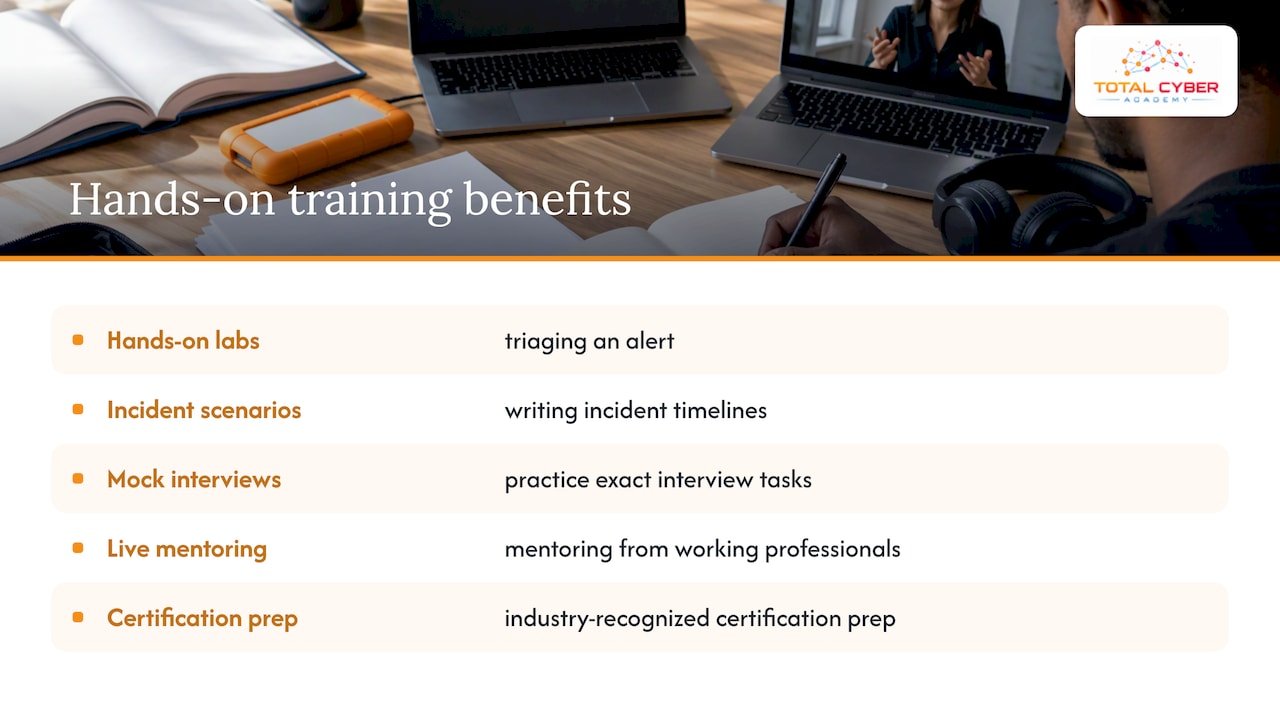
Interview questions test whether a candidate can do the work, not just describe it, and that is where hands-on training closes a gap that classroom-only preparation leaves open. Programs that include labs, guided incident scenarios, and mock interviews give candidates practice at the exact tasks interviewers ask about, such as triaging an alert or writing up an incident timeline.
A well-established training organization offers hands-on labs, industry-recognized certification preparation, and live mentoring from working cybersecurity professionals. Its role-based programs cover security engineering, penetration testing, IT operations, and cloud engineering, and the emphasis on practical skill-building over exam memorization mirrors what hiring managers describe wanting from candidates. Our beginner’s career guide explains how these training pathways map to the skills covered in this article.
7. Why hiring managers reward reasoning over recall
The clearest pattern in recent hiring research is that technical recall alone rarely wins an offer. Hiring managers consistently rank problem-solving, collaboration, and communication as decisive factors, often ahead of narrow tool expertise, which means a candidate who can reason through an unfamiliar scenario out loud tends to outperform one who has memorized definitions. Growth potential matters as much as current depth. The three behaviors worth rehearsing most are clear communication under pressure, methodical technical reasoning, and blameless incident storytelling, since these three show up in nearly every interview format regardless of role.
— Alden
8. Turn this practice into a training plan that gets results
Reading a list of questions gets you familiar with the material, but interviews reward candidates who have actually done the work, not just studied it. This training provider builds that experience through hands-on labs, instructor-led mentoring, and mock interview practice woven directly into its certification and career programs.
A few paths map directly to what this article covers: the CompTIA Security+ course builds the fundamentals covered in the technical question sections, the Penetration Tester Program develops the scoping and reporting skills pentest interviews test for, and the Cybersecurity Engineer Program covers the detection and incident response depth SOC and blue team interviews expect.
- Hands-on labs that mirror real alert triage and incident write-up tasks.
- Live mentoring from working cybersecurity professionals, not recorded lectures alone.
- Role-based programs aligned to SOC, blue team, and penetration testing career paths.
Browse the full course catalog to find the program that matches the role you’re interviewing for next.
Sources
This article draws on NICE (NIST) workplace skills guidance, CISA’s incident response plan basics, and multiple ISC2 hiring trends studies on skill priorities and early-career hiring practices, alongside curated practice question sets from university career centers.
FAQ
What are the 5 C’s of interviewing?
Definitions vary across career resources, and no single source ties this term specifically to cybersecurity interviews. Focus instead on the traits hiring managers consistently value in this field: problem-solving, communication, collaboration, accountability, and a willingness to keep learning.
What are the top 50 cybersecurity interview questions?
There is no single official list of questions, but comprehensive practice sets covering technical fundamentals, tools, incident response, networking, and behavioral prompts are available from university career centers, including a 61-question practice list from Rutgers. The categorized list in this article covers the same core areas those sets draw from.
What are the 5 hardest interview questions?
The hardest questions tend to be open-ended scenario prompts, such as being asked to walk through detecting and containing a live incident with incomplete information. These are difficult because they test reasoning and communication under pressure rather than a single factual answer, which is exactly what hiring managers say they weigh most heavily.
What are the five C’s of cybersecurity?
This phrase is not tied to a recognized industry framework, so treat any specific enumeration with caution. If you encounter it in an interview, it likely refers loosely to core security concepts like confidentiality, integrity, compliance, and similar principles rather than a standardized model.
How should I prepare for a skills-based cybersecurity assessment?
Practice hands-on tasks like log analysis, alert triage, or basic scripting rather than only reviewing definitions, since many employers now test practical ability directly. A 2025 ISC2 study found that a large share of organizations use skills-based assessments for entry and junior-level hires, so treat a practical test as likely rather than optional.