
Start your transition with a 30/60/90 networking plan that prioritizes bridge connections and warm introductions over mass applications. Roughly 70–80% of jobs are filled through networking and referrals, not posted listings, according to veteran transition guides. This means the first and most consequential investment you can make is in people, not job boards.
Here is what to do in the next 48 hours:
- Reconnect with three existing contacts — a fellow veteran who has already made the civilian transition, a contractor you worked alongside, or a family member in your target industry.
- Write a forwardable email — a 150-word message your connectors can send on your behalf without editing. Store it in your drafts folder.
- Update your LinkedIn headline to reflect your target role, not your MOS or rank.
- Register for one veteran-focused platform — LinkedIn, RecruitMilitary, or Hiring Our Heroes — and complete your profile before reaching out to anyone.
- Identify one informational interview target from your existing network and draft a 20-minute meeting request.
These five steps are the foundation of every effective networking strategy for veterans making a career change. The sections that follow build the full playbook.
Table of Contents
- How to clarify your networking goals before you reach out
- How to map and prioritize the contacts you already have
- How to translate your military experience into civilian language
- Where to find bridge connections and veteran-focused resources
- What does an effective LinkedIn profile look like for veterans?
- How to prepare for hiring events and informational interviews
- Ready-to-use outreach templates for veterans
- How to follow up and turn conversations into lasting relationships
- What are realistic timelines and costs for veteran networking?
- Common networking mistakes veterans make and how to recover
- Why bridge connections and the “I’m exploring” frame actually work
- Your 30/60/90-day networking action checklist
- Key Takeaways
- The networking advice most veterans receive is incomplete
- Totalcyber’s career prep program for veteran career changers
- Useful sources and next reads for veterans
How to clarify your networking goals before you reach out
Vague networking produces vague results. Before sending a single message, define two or three concrete goals that give every outreach a clear purpose and a measurable outcome.

A useful goal follows this structure: audience, role, city, desired outcome, timeline. For example: “Operations management roles in Denver — six informational interviews in 60 days.” That single sentence tells you who to contact, what to ask for, and when to evaluate progress. Without it, you will drift toward conversations that feel productive but generate no referrals.
Three goal types cover most veteran transitions:
- Mentorship — one or two senior professionals in your target field who can advise on industry norms, introduce you to hiring managers, and review your materials over a sustained period.
- Informational interviews — six short conversations (20 minutes each) with people currently doing the work you want to do. These are intelligence-gathering sessions, not job requests.
- Warm introductions to hiring managers — three direct referrals from connectors who can vouch for your character and capability.
Your timeline determines which goal to pursue first. If you are still on active duty with 90 or more days before separation, prioritize mentorship and informational interviews. You have time to build relationships before you need them. If you are actively job-seeking right now, shift immediately to warm introductions and referrals — those convert fastest. The Society for Industrial and Organizational Psychology (SIOP) frames this distinction as the difference between exploratory networking and targeted networking, and the two require different outreach scripts.
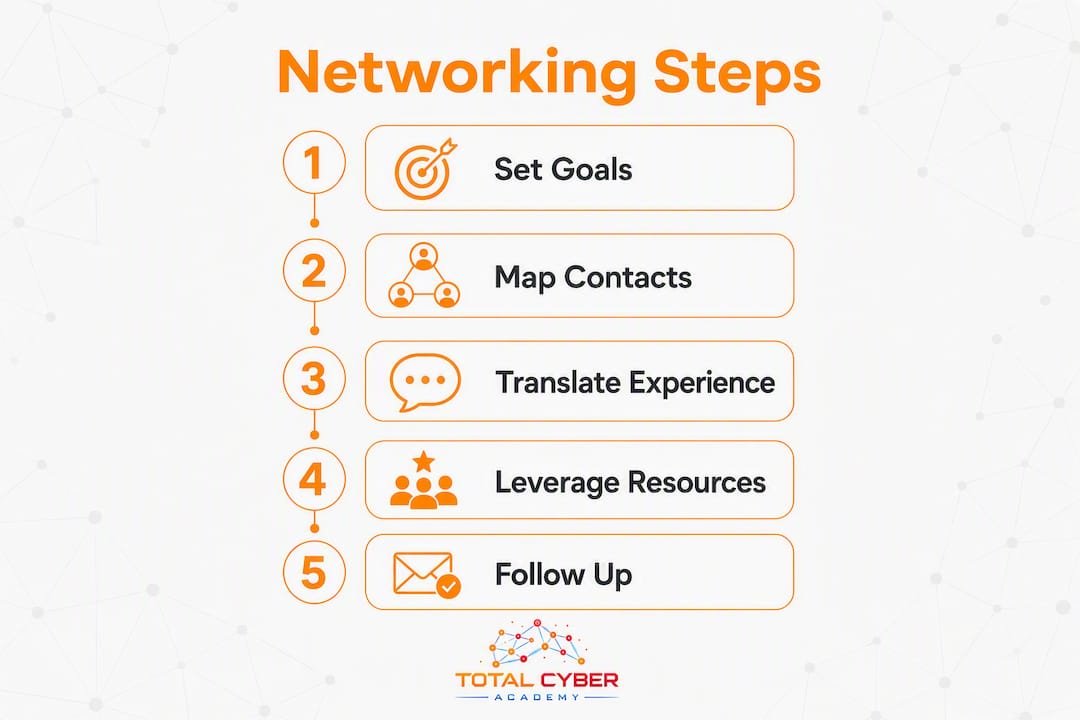
How to map and prioritize the contacts you already have
Your existing network is almost certainly larger than you think. The goal of contact mapping is to surface warm connections before resorting to cold outreach.
- Collect every contact — across four categories: military peers and supervisors, contractors and civilians you worked with on base, family and personal connections, and alumni from TAP/TAPS, service academies, or veteran programs.
Sample reconnect message to an immediate contact:
Keep it short, specific, and low-pressure. The ask is a conversation, not a job.

How to translate your military experience into civilian language
Recruiters scan resumes for civilian role titles and quantified outcomes. MOS codes and military acronyms register as noise to most civilian hiring managers, even those who respect military service.
The translation principle is straightforward: replace the title with its civilian equivalent, then replace the duty description with an outcome statement that includes a metric. Here is what that looks like in practice:
| Military Role / Bullet | Civilian Title | Civilian Outcome Language |
|---|---|---|
| Signal Support Systems Specialist | IT Support Technician / Network Technician | Maintained communications infrastructure for multiple personnel across three forward operating bases |
| Combat Medic | Emergency Medical Technician / Clinical Operations Coordinator | Provided emergency care for a battalion; reduced response time by coordinating triage protocols |
| Automated Logistical Specialist | Supply Chain Analyst / Inventory Manager | Managed equipment accountability with zero loss during deployment |
| Operations NCO (S3 shop) | Operations Manager / Program Coordinator | Planned and executed 40+ training events annually, coordinating across six departments |
| Information Systems Security Officer (ISSO) | Cybersecurity Analyst / Information Security Officer | Enforced security controls for classified networks; zero reportable incidents |
Two rules govern every translation. First, never use an acronym a civilian HR professional would not recognize. Second, every bullet should answer the question: “What happened because of what you did?” If your bullet does not contain a number or a concrete outcome, add one before sending any application or outreach.
For veterans targeting cybersecurity specifically, the military-to-IT skills mapping at Totalcyber provides a detailed breakdown of how common military roles translate to CompTIA, EC-Council, and ISC2 certification pathways.
Where to find bridge connections and veteran-focused resources
Bridge connections are veterans who have already made the transition into your target industry. They understand both worlds, respond at higher rates than civilian cold contacts, and can introduce you to hiring managers with a credible endorsement. Prioritize them above all other outreach.
Primary platforms and programs:
- LinkedIn — the primary digital platform for professional networking. Optimize your headline and summary first, then search for veterans in your target role using the “Alumni” and “People” filters. Engage with posts for 15 minutes daily before sending connection requests; active engagement increases inbound responses from recruiters and peers.
- RecruitMilitary — hosts career fairs and an online job board specifically for transitioning service members. Attend at least one virtual or in-person event early in your search to practice your pitch in a low-stakes environment.
- Hiring Our Heroes — a U.S. Chamber of Commerce Foundation program that has hosted more than 275 Career Summits connecting transitioning service members with employers committed to military hiring. Their events include industry-focused workshops, hiring fairs, and networking sessions. Register for the next summit in your region as soon as you identify your target industry.
- SIOP (Society for Industrial and Organizational Psychology) — relevant for veterans targeting human resources, organizational development, or workforce analytics roles. SIOP’s annual conference and regional events offer access to practitioners who hire for these functions.
Additional programs worth contacting:
- American Corporate Partners (ACP) — a free, yearlong mentorship program that pairs veterans with corporate mentors from major U.S. companies. Apply at acp-usa.org; ACP typically responds within one business day and makes a mentor match within several weeks. Topics covered include resume review, networking, career exploration, and interview preparation.
- SkillBridge — a DoD program allowing active-duty service members to work with civilian employers during the final 180 days of service. It is one of the most direct bridge-connection opportunities available. The Totalcyber SkillBridge guide explains how to combine it with cybersecurity training.
- TAP (Transition Assistance Program) — mandatory pre-separation counseling that includes networking workshops and employer panels. Treat every TAP contact as a potential bridge connection.
- VFW and Team RWB — veteran service organizations with local chapters. Both host events that generate peer introductions and, occasionally, direct employer referrals.
Event-prep checklist for hiring fairs and meetups:
- Research three to five employers attending the event before you arrive.
- Prepare a 30-second introduction (name, branch, target role, one key accomplishment).
- Bring printed copies of your civilianized resume.
- Set a goal of one to two high-value conversations rather than collecting business cards from every booth.
- Plan your follow-up message before you leave the house.
What does an effective LinkedIn profile look like for veterans?
LinkedIn remains the single most important digital tool for veteran career changers. A complete, civilian-facing profile generates inbound interest; an incomplete or military-jargon-heavy profile does the opposite.
Profile checklist:
- Photo: professional headshot, plain background, civilian attire.
- Headline: target role + one differentiator. Example: “Cybersecurity Analyst | CompTIA Security+ | 8 Years Military Intelligence.”
- Summary (About section): three to four sentences. State your transition, your target role, and one concrete accomplishment. End with a call to connect.
- Experience: civilianized titles and outcome-focused bullets (see the translation table above).
- Skills: add at least 10 skills aligned to your target role; ask three connections to endorse the top three.
- Education and certifications: include any military training that maps to civilian credentials (e.g., JPAS/DISS experience maps to security clearance management).
The LinkedIn Ready course at Totalcyber walks through each of these elements with templates specific to IT and cybersecurity roles.
Outreach do’s and don’ts:
| Do | Don’t |
|---|---|
| Keep connection requests to 150 words or fewer | Send the default “I’d like to add you to my network” message |
| Mention a mutual connection or shared experience | Send the same message repeatedly without personalization |
| Reference a specific post, article, or company initiative | Ask for a job in the first message |
| Follow up once after no response | Send more than two follow-up messages to a cold contact |
Three sample LinkedIn headlines for common target roles:
- Operations: “Operations Manager | Supply Chain & Logistics | 10 Years U.S. Army | PMP Candidate”
- Cybersecurity: “IT Security Analyst | CompTIA Security+ | Former Army ISSO | Cleared TS/SCI”
- Logistics: “Logistics Coordinator | Transportation & Distribution | 8 Years USMC | Lean Six Sigma Green Belt”
How to prepare for hiring events and informational interviews
Preparation separates veterans who leave events with follow-up meetings from those who leave with a stack of business cards they never use.
- Write your 30-second pitch before any event. Structure: name, branch and years of service, target role, one specific accomplishment, and what you are looking for. Practice it aloud until it sounds natural, not recited.
- Extend to 60 seconds for informational interviews by adding context about why you are targeting this specific industry or company. The extra 30 seconds should answer “why here?” not add more credentials.
- Frame informational interview requests correctly. The most effective framing is: “I’m exploring a transition into [field] and you’re one of the people whose path I’d most like to understand. Could I have 20 minutes of your time?” Career coaches call this the “I’m exploring; you’re the expert” frame because it positions the contact as an advisor rather than a gatekeeper, which increases acceptance rates.
- Prepare five high-value questions for informational interviews: What does a typical week look like in your role? What skills do you wish you had developed earlier? What do you look for when you refer someone to a hiring manager? How did you break into this field? What should I read or do in the next 90 days?
- Arrive early at in-person events. The first 30 minutes, before the room fills, is when hiring managers are most accessible and least fatigued.
Pro Tip: Target one to two substantive conversations per event rather than working the entire room. A 15-minute conversation that ends with a scheduled follow-up call is worth more than 10 two-minute exchanges.
Ready-to-use outreach templates for veterans
Three templates cover the most common outreach scenarios. Customize the bracketed fields; keep everything else tight.
Veteran-to-veteran LinkedIn connection request
Forwardable introduction email (for a connector to send on your behalf)
Store this in your sent folder. Pre-written forwardable emails remove friction for connectors and significantly increase the odds of a warm introduction actually happening.
Recruiter or hiring manager follow-up after a career fair
Recommended follow-up sequence:
- Within 24–48 hours: send a thank-you message referencing one specific detail from the conversation.
- At one week: a brief check-in if no response, adding one piece of value (a relevant article, a mutual connection’s name).
- At two weeks: a final, short follow-up. After two unanswered messages, move on. This cadence is the professional standard for remaining top-of-mind without becoming intrusive.
How to follow up and turn conversations into lasting relationships
A single conversation rarely produces a referral. The relationship between the conversation and the referral is built in the follow-up period, through small, consistent actions that demonstrate genuine interest rather than transactional intent.
| Timing | Action | Purpose |
|---|---|---|
| 24–48 hours after meeting | Personalized thank-you message | Confirm the connection; reference a specific detail |
| 1 week | Share a relevant article or resource | Add value before making any ask |
| 2 weeks | Brief check-in or status update | Stay visible; signal continued interest |
| Monthly (ongoing) | Congratulate on a promotion, comment on a post, or offer an introduction | Maintain the relationship without an agenda |
The give-before-you-receive principle is the operating logic here. Every value action you take — sharing a useful article, congratulating a contact on a promotion, offering to introduce two people in your network — builds reciprocity without a direct ask. Most veterans who struggle with networking are not doing anything wrong in the initial conversation; they are simply not following up with value before they need something.
When a contact has responded positively to two or three exchanges and has demonstrated knowledge of your target field, that is the right moment to escalate: ask for a warm introduction to a specific person, or ask whether they would be willing to serve as an informal advisor for 90 days. Keep the ask specific and time-bounded.
What are realistic timelines and costs for veteran networking?
Networking is not a single event; it is a campaign. Setting realistic benchmarks prevents the discouragement that causes most veterans to abandon their outreach before it produces results.
30/60/90-day benchmarks:
These are realistic targets for a veteran dedicating 60–90 minutes per day to networking activity. Results vary by industry, geography, and how warm the existing network is.
Common costs to budget:
- Event travel: — varies widely. Hiring Our Heroes Career Summits and RecruitMilitary events are often free to attend; travel and lodging are the primary costs for in-person events outside your metro area.
Tracking every contact in a simple spreadsheet — with columns for priority, date of last outreach, next action, and who introduced you — is the single most effective way to maintain momentum across a 90-day campaign. Update it weekly.
Common networking mistakes veterans make and how to recover
Most networking failures are not failures of personality or connection. They are failures of timing, framing, or follow-through.
- Failing to translate military language — Using MOS codes, acronyms like NCOIC or S6, or rank-based titles in civilian outreach signals that you have not yet made the mental shift to the civilian context. Translate everything before it leaves your drafts folder.
Recovery script for a relationship you let go cold:
Honesty about the gap, combined with a low-pressure ask, recovers most dormant relationships.
Why bridge connections and the “I’m exploring” frame actually work
The effectiveness of veteran-to-veteran networking is not anecdotal. Practitioner guidance consistently shows that veteran-to-veteran outreach produces higher response rates than generic cold messaging, because shared military experience creates an immediate trust signal that civilian professional relationships take months to build.
The “I’m exploring; you’re the expert” framing works for a specific psychological reason: it removes the social cost of saying yes. When you frame a request as research rather than a job ask, the contact does not feel responsible for your employment outcome. They are simply sharing expertise. Career coaches who specialize in veteran transitions report that this framing increases acceptance rates for informational interview requests compared with direct asks for job leads or referrals.
Two practical applications:
- Personalize veteran-to-veteran templates by referencing a shared branch, deployment region, or occupational specialty. Even a single shared detail converts a cold message into a warm one.
- Use informational interviews as intelligence-gathering. The goal of the first conversation is not a referral; it is understanding. Referrals emerge naturally from contacts who feel genuinely heard and respected, not from contacts who were asked for one.
Your 30/60/90-day networking action checklist
- Days 8–14: — Send reconnect messages to all Priority 1 contacts. Request three informational interviews. Register on RecruitMilitary and Hiring Our Heroes.
Key Takeaways
Veterans who prioritize bridge connections, forwardable outreach, and a structured 30/60/90 plan convert networking activity into referrals faster than those who rely on mass applications or cold messaging alone.
| Point | Details |
|---|---|
| Start with warm contacts | Score existing contacts Priority 1–3 and send reconnect messages before any cold outreach. |
| Write a forwardable email | A pre-written 150-word intro email removes friction for connectors and increases warm introductions. |
| Use the “I’m exploring” frame | Framing informational interview requests as research, not job asks, increases acceptance rates. |
| Follow the 24-hour / 1-week / 2-week cadence | Send a thank-you within 48 hours, a check-in at one week, and a final follow-up at two weeks. |
| Totalcyber for structured career prep | Totalcyber’s Career Prep Course pairs LinkedIn and resume coaching with hands-on IT training for veterans. |
The networking advice most veterans receive is incomplete
Veterans entering civilian job markets are routinely told to “put themselves out there” and “leverage their military experience.” Both instructions are true and nearly useless without the operational specificity that military training demands.
The gap is not motivation. Veterans are, as a group, exceptionally disciplined about executing plans. The gap is translation: translating military accomplishments into civilian language, translating the concept of networking from a social activity into a structured campaign, and translating the instinct to be self-sufficient into the willingness to ask for help from people who genuinely want to give it.
Three lessons stand out from observing veteran transitions closely. First, the veterans who move fastest are not the ones with the most impressive service records; they are the ones who build a small advisory board early and ask those advisors for specific introductions. Second, the forwardable email is consistently underused. Most veterans write it once, feel awkward about it, and never send it. The veterans who share it freely get more introductions in two weeks than others get in two months. Third, the informational interview is not a courtesy call. It is the primary mechanism by which civilian hiring managers decide whether to take a risk on someone they do not yet know. Treat every 20-minute conversation as a high-stakes professional interaction, prepare for it accordingly, and follow up within 24 hours without exception.
The checklist in this article is not a suggestion. It is a campaign plan. Execute it with the same discipline you brought to every operational mission.
Totalcyber’s career prep program for veteran career changers
Veterans who pair structured training with active networking close the credibility gap faster than those who network alone. A CompTIA Security+ certification or a completed cybersecurity lab gives your contacts something concrete to forward to a hiring manager, and it gives you a specific, civilian-recognized credential to anchor every conversation.
Totalcyber is a veteran-owned cybersecurity training organization built specifically for career changers, veterans, and entry-level IT professionals. The Career Prep Course combines LinkedIn profile optimization, resume coaching, and interview preparation with hands-on technical labs and certification exam prep for CompTIA, EC-Council, and ISC2 credentials. Instructor-led and on-demand formats mean you can train around a job search schedule. If you are targeting cybersecurity or IT as your civilian field, the cybersecurity career roadmap is the right starting point. Enroll today and give your network something worth forwarding.
Useful sources and next reads for veterans
- Hiring Our Heroes — strategic networking guidance and a calendar of Career Summits across the U.S. Use this to find the next in-person event in your region and register before spots fill.
- American Corporate Partners (ACP) — free yearlong mentorship program matching veterans with corporate mentors. Apply early; mentor matches take several weeks. Covers resume review, networking, career exploration, and interview prep.
- Military Transition Toolkit — Networking Guide — practitioner-written guide covering the 70–80% networking statistic and give-before-you-receive principles. Read this before your first outreach.
- Totalcyber — TAP Program and IT Careers Guide — explains how to use TAP contacts and transition workshops as a networking foundation for IT and cybersecurity roles.
- Totalcyber — SkillBridge Cybersecurity Training — if you have 180 days or fewer before separation, SkillBridge combined with cybersecurity training is one of the fastest paths to a civilian credential and a bridge connection in your target field.
- VA News — ACP Mentorship Program — VA-published overview of ACP’s application process and what to expect from the mentor match. Use this to understand the program before applying.
Recommended
- Career Changer Cybersecurity Success Roadmap: 2026 Guide – Total Cyber Academy!
- CompTIA vs. SANS Training for Veterans: Start Here – Total Cyber Academy!
- Veteran Cybersecurity Certification Study Guide 2026 – Total Cyber Academy!
- The Role of Military Skills in IT: A 2026 Career Guide – Total Cyber Academy!