
On-the-job training in IT is defined as structured, role-based learning where employees build practical skills by performing actual job tasks under guided supervision using live systems and real work environments. The industry term is “workplace-based learning,” though most hiring managers and training programs simply call it OJT. Unlike classroom instruction alone, OJT in cybersecurity places learners directly inside tools like SIEM platforms and EDR solutions from day one. Organizations aligned with NIST, CISA, and CIS Controls treat OJT as a core component of workforce development, not an optional supplement. For anyone entering or advancing in an IT or cybersecurity role, understanding how OJT works is the first step toward building a career that holds up under real pressure.
What is on-the-job training in IT and cybersecurity?
On-the-job training in IT is hands-on, role-specific learning that happens inside the actual work environment, not in a lecture hall. The on-the-job training definition most relevant to cybersecurity focuses on task performance with live tools, guided by experienced practitioners. Learners do not simulate a job. They perform it, with support, from the start.
Effective OJT programs use live systems rather than theoretical walkthroughs. That distinction matters because reading about a SIEM alert and triaging one in real time are completely different cognitive tasks. The gap between knowing a concept and executing it under pressure is where most new IT professionals struggle.

Regulatory frameworks including NIST CSF, GDPR, HIPAA, and PCI-DSS all require documented, role-appropriate training. That requirement pushes organizations toward structured OJT rather than informal “figure it out” onboarding. Compliance is not just a checkbox. It is a forcing function that makes training more deliberate and measurable.
The importance of on-the-job training also shows up in retention. Employees who receive structured, role-relevant training stay longer and perform better than those dropped into roles without support. That outcome benefits both the individual and the organization.
What does effective on-the-job training look like in IT?
Effective OJT in cybersecurity has specific structural characteristics that separate it from generic workplace orientation. Simulation-based blended learning that combines instructor-led sessions, on-demand content, and hands-on labs consistently outperforms classroom-only methods. Organizations using cyber range training report more than twice the ROI compared to lecture-based programs. That gap reflects how much faster skills solidify when learners work with real scenarios.
High-performing programs follow a structured cadence:
- Role-based onboarding aligned to the specific tools and data the learner will access
- Cyber range exercises that simulate real incident scenarios including phishing, ransomware, and lateral movement
- Quarterly refresher sessions to address new threat vectors and update procedures
- Incident response drills conducted one to two times per year to test team readiness
- Compliance documentation tied to frameworks like NIST SP 800-53 and CIS Controls
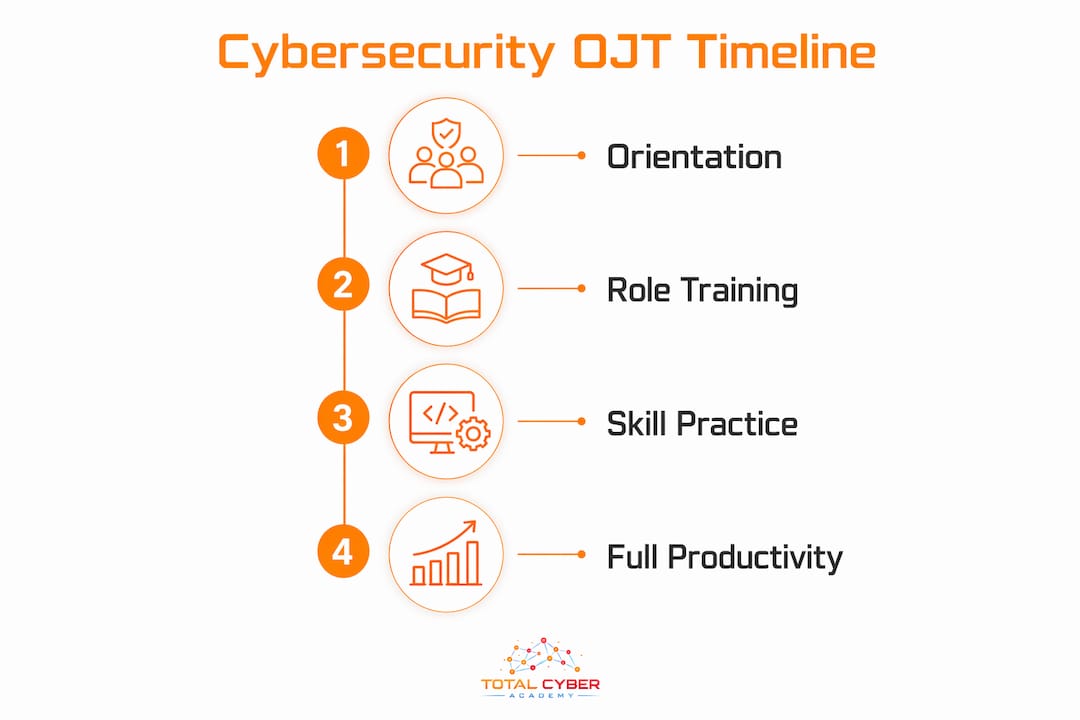
Duration matters as well. Most structured OJT programs in cybersecurity run 12–18 months before a learner reaches full independent productivity. That timeline reflects the complexity of the field, not a failure of the learner.
Pro Tip: Ask your employer or training program which specific framework governs your role’s training requirements. Knowing whether you are working toward NIST CSF alignment or CIS Controls compliance shapes which skills you should prioritize first.
What are common roles trained through cybersecurity OJT?
Three entry-level roles dominate cybersecurity OJT pipelines: SOC Analyst, Penetration Tester, and GRC Analyst. Each role has a distinct skill-building timeline and a different set of daily tasks. Understanding the differences helps learners choose the right path before investing months of effort.
Role-based training paths allocate training priority by data access level and job function sensitivity. A SOC Analyst needs deep familiarity with SIEM dashboards and alert triage. A Penetration Tester needs scripting skills and knowledge of exploitation frameworks. A GRC Analyst needs to understand regulatory mapping and risk documentation.
| Role | Core OJT Tasks | Skill-Building Timeline | Hourly Wage Range |
|---|---|---|---|
| SOC Analyst | SIEM monitoring, alert triage, incident logging | 3–6 months | $15–$30/hour |
| Penetration Tester | Vulnerability scanning, exploitation, reporting | 6–9 months | $25–$45/hour |
| GRC Analyst | Risk assessments, compliance mapping, policy review | 3–6 months | $18–$35/hour |
Each of these roles builds capability through repetition with real tools. A SOC Analyst who has triaged 500 alerts develops pattern recognition that no certification exam can replicate. That experience is what hiring managers are actually evaluating when they review a resume.
For learners following a cybersecurity career roadmap, knowing which role fits your background and goals shortens the path to employment significantly.
How does adaptive onboarding improve cybersecurity training outcomes?
Adaptive onboarding tailors training content to the specific role, data access level, and threat exposure of each employee. Static onboarding gives everyone the same content regardless of job function. Adaptive onboarding treats a SOC Analyst and a GRC Analyst as fundamentally different learners, because they are.
The results of adaptive approaches are measurable. Role-specific onboarding reduces repeat phishing susceptibility by 63%. That figure reflects a direct behavioral change, not just a knowledge gain. Employees who understand why a policy exists are more likely to follow it than those who only sign a compliance form.
Effective adaptive onboarding follows a clear sequence:
- Map the role to its specific data access level and threat exposure before training begins.
- Assign targeted modules covering the tools, threats, and procedures relevant to that function.
- Run simulated scenarios including phishing tests and incident response exercises tied to real job tasks.
- Document completion and outcomes to satisfy NIST SP 800-53 and CIS Controls audit requirements.
- Schedule quarterly reviews to update training content as the threat environment evolves.
Cybersecurity compliance frameworks reinforce this approach by requiring organizations to demonstrate that training is both role-appropriate and regularly updated. That requirement makes adaptive onboarding a legal and operational necessity, not just a best practice.
Pro Tip: If your organization uses a static, one-size-fits-all security awareness program, advocate for role-based segmentation. Even splitting learners into two groups, technical and non-technical, produces measurably better outcomes.
What are the best practices for succeeding in IT OJT?
Success in cybersecurity OJT depends on how proactively learners engage with the work, not just how many hours they log. Hiring managers evaluate candidates on demonstrated capability, specifically evidence of independent problem-solving and real incident investigation. The top 5% of candidates show proof of setting up infrastructure, analyzing logs, and documenting findings on their own initiative.
The most effective learners treat OJT as an opportunity to build a portfolio, not just complete tasks. Documenting investigation choices and the reasoning behind each decision creates credible evidence of skill that a certification list cannot provide. That portfolio becomes the primary differentiator in a competitive hiring process.
Practical strategies that consistently produce results include:
- Observe top performers in your team and document exactly how they handle incidents, escalations, and tool configurations.
- Build a lab environment at home or through a training platform to practice scenarios outside of work hours.
- Write up every significant incident you work on, including your analysis, the tools you used, and the outcome.
- Learn the “why” behind each process, not just the steps. Evidence-based training focuses on standardized workflows derived from top-performer practices, which means understanding the rationale makes you faster and more consistent.
- Ask for stretch assignments that push you into unfamiliar territory, such as a different tool or a new threat category.
Certifications like CompTIA Security+ or CySA+ validate foundational knowledge. They do not replace demonstrated capability. The learners who advance fastest combine certification preparation with active portfolio building and use each as evidence of the other.
Preparing for interviews is also part of the OJT process. Reviewing a cybersecurity interview guide before your first role helps you articulate what you have actually done, not just what you have studied.
Key Takeaways
On-the-job training in IT is the most direct path to cybersecurity employment because it builds the demonstrated, role-specific capability that hiring managers prioritize over credentials alone.
| Point | Details |
|---|---|
| OJT definition in IT | Structured, role-based learning using live tools and real work environments, not classroom theory. |
| Effective program structure | Blended learning with cyber ranges, quarterly refreshers, and incident drills outperforms lecture-only methods. |
| Role-specific timelines | SOC Analyst, Pen Tester, and GRC Analyst roles each require 3–9 months of OJT to reach full productivity. |
| Adaptive onboarding impact | Role-tailored onboarding reduces repeat phishing by 63% and improves compliance culture measurably. |
| Portfolio over certifications | Documenting real incident investigations builds hiring evidence that certification lists cannot replicate. |
Why the “learn by doing” shift in cybersecurity is permanent
The cybersecurity field has moved decisively away from credential-first hiring. I have watched this shift accelerate over the past several years, and the direction is clear: employers want proof of capability, not proof of study.
What strikes me most is how many learners still treat certifications as the destination rather than the starting point. A CompTIA Security+ tells a hiring manager you understand the vocabulary. A documented incident investigation tells them you can actually do the work. Those are not the same signal.
The learners I have seen advance fastest are the ones who treat every OJT task as a writing assignment. They document what they did, why they did it, and what they would do differently. That habit builds a portfolio that speaks for itself in any interview. It also forces a level of reflection that accelerates skill development far beyond passive task completion.
The other pattern worth noting is that the best OJT programs are not the most expensive ones. They are the ones that give learners access to real scenarios, real tools, and real feedback quickly. Cyber ranges, live labs, and veteran-led instruction consistently outperform polished video libraries with no hands-on component. If your current training path does not include regular, realistic practice under pressure, that is the gap to close first.
— Alden
Totalcyber’s role-based training programs for IT careers
Totalcyber is a veteran-owned cybersecurity training organization built specifically for learners who need practical, career-ready skills, not just theory. Every program at Total Cyber Academy is designed around the same principles that make OJT effective: hands-on labs, real-world scenarios, and expert instruction from practitioners who have worked in the field.

Whether you are starting from zero or transitioning from another career, Totalcyber offers structured cybersecurity courses that align with CompTIA, EC-Council, and NIST-recognized frameworks. Programs include certification preparation, live lab environments, and career support designed to move you from training to employment. Veterans, career changers, and IT professionals all find a clear path forward through Totalcyber’s structured, role-focused curriculum.
FAQ
What is on-the-job training in IT?
On-the-job training in IT is structured, role-based learning where employees build practical skills by performing actual job tasks using live tools and real systems under guided supervision.
How long does cybersecurity OJT typically take?
Most cybersecurity OJT programs run 12–18 months to full productivity, with role-specific skill-building timelines of 3–9 months depending on the position.
What are examples of on-the-job training in cybersecurity?
Common examples include SIEM alert triage for SOC Analysts, vulnerability scanning and exploitation exercises for Penetration Testers, and compliance mapping for GRC Analysts.
Does OJT replace certifications in IT hiring?
OJT does not replace certifications, but hiring managers prioritize demonstrated capability over credential lists. Combining certifications with a documented portfolio of real incident work produces the strongest hiring outcome.
How does adaptive onboarding differ from standard security training?
Adaptive onboarding tailors training content to each employee’s specific role, data access level, and threat exposure. Standard onboarding delivers the same content to everyone regardless of job function, which produces weaker compliance and retention outcomes.