
DoD 8140 requires role-based qualification built on three pillars: foundational training, resident (job-specific) training, and continuous professional development. It applies to Service members, DoD civilians, and contractors, and every qualification must be documented in an authoritative personnel system. Foundational requirements are due within 9 months of assignment; resident requirements within 12 months.
TL;DR:
- Foundational qualifications must be completed within nine months of assignment, while resident qualifications are due within twelve months, with contractors expected to meet requirements at the start of work.
- Training must align with at least 70% of key tasks and KSATs to qualify, and recent, relevant experience can grandfather older coursework.
- Qualification data must be entered into authoritative systems like DMDC, not just kept in personal records, and verification should be checked about 30 days after submission.
- Different DoD components may impose stricter or additional requirements than the enterprise baseline, and personnel may need separate qualifications for multiple roles.
- Approved training is listed in the DoD Qualification Matrix, which is updated regularly, and hands-on, scenario-based courses are preferred for effective KSAT mapping.
Table of Contents
- Understanding DoD 8140 Requirements: The Governing Rule Set
- Who Must Comply With DoD 8140, and Who Sets the Rules Locally
- Qualification Components: Foundational, Resident, and CPD
- How Long You Have to Qualify Under DoD 8140
- Tracking and Documenting Your Qualification Status
- Using the DoD 8140 Qualification Matrix to Find Approved Training
- What Actually Counts as Useful Training for DoD 8140
- A Compliance Note From Total Cyber Academy
- Get Foundational-Ready Training Through Total Cyber Academy
- Where to Verify DoD 8140 Policy Directly
- Sources
Understanding DoD 8140 Requirements: The Governing Rule Set
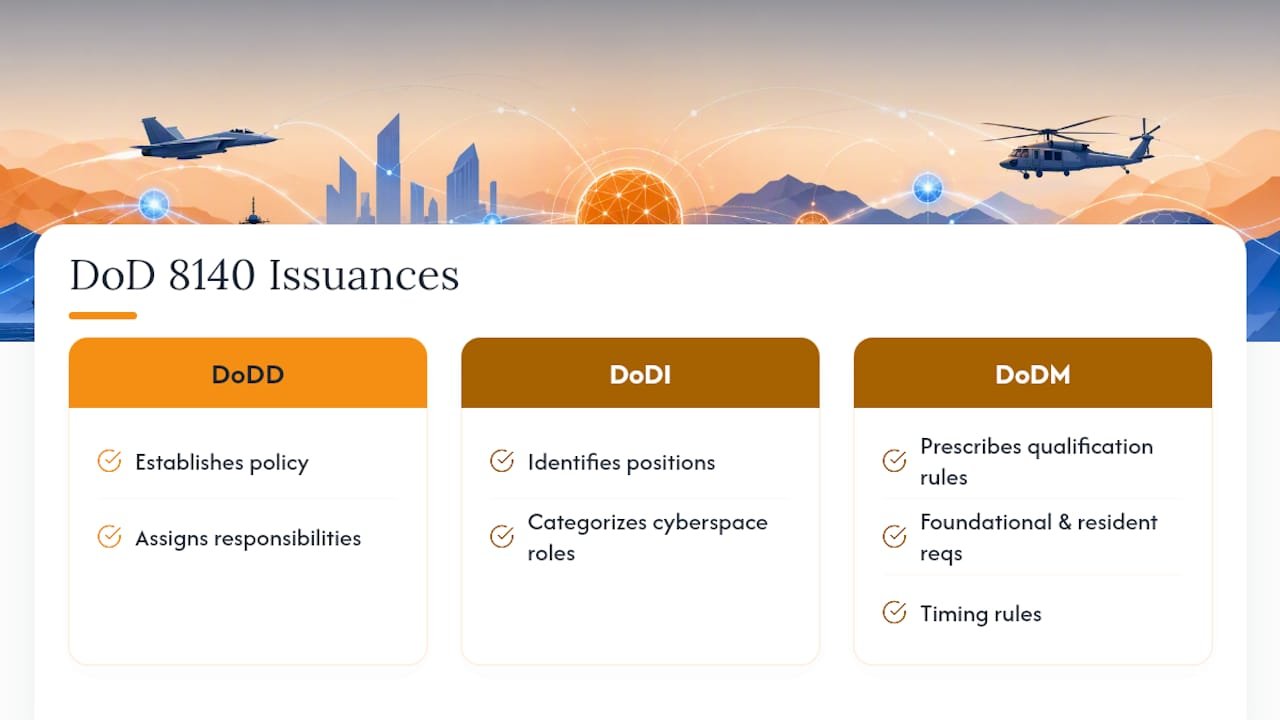
DoD 8140 is not a single document. It is a family of issuances, each with a distinct job. DoDD 8140.01 establishes the policy and assigns responsibilities across the department. DoDI 8140.02 sets the identification and categorization rules for cyberspace positions. DoDM 8140.03 does the heavy lifting: it prescribes how qualification actually works, including the foundational and resident requirements and the timing rules that govern them.
Underneath all three sits the DoD Cyber Workforce Framework (DCWF), which organizes the workforce into seven elements: IT, Cybersecurity, Cyberspace Effects, Cyber Intelligence, Data/AI, Software Engineering, and Cyber Enablers. Every DCWF work role carries its own set of knowledge, skills, abilities, and tasks (KSATs), and the framework requires that personnel assigned to a work role be fully qualified for it, not merely certificate-holding.
That distinction matters because DoD 8140 replaced the older DoD 8570 approach, which measured readiness mostly through certification checklists at fixed information assurance levels. The newer model asks whether you can actually perform the work role’s tasks.
Who Must Comply With DoD 8140, and Who Sets the Rules Locally
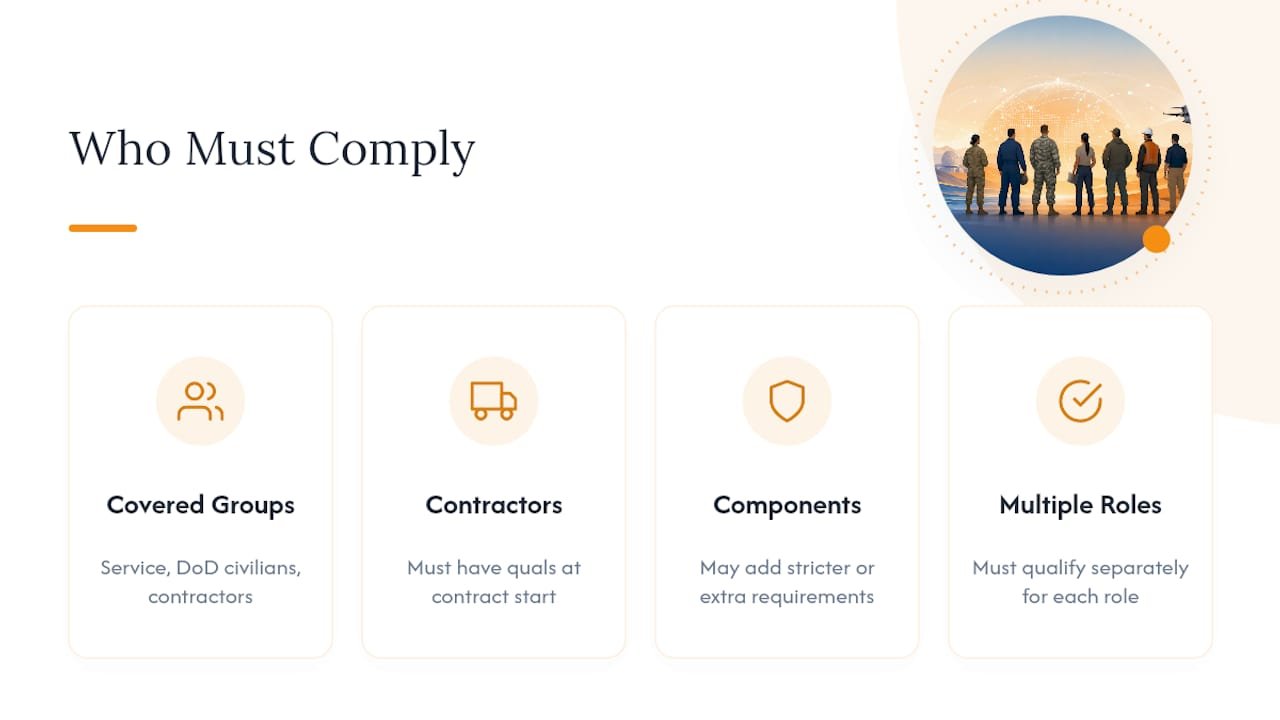
Coverage extends to three groups: Service members, DoD civilian employees, and contractors performing cyberspace work for the department. Contractors carry a specific rule: they must meet foundational qualification requirements at the commencement of contract performance, not sometime after the fact. Components can also write resident qualification obligations into contract language, so a contractor’s actual burden depends on what the specific contract requires.
Beyond that baseline, DoD components retain authority to layer on stricter or additional requirements for their own workforce. The enterprise-level matrix is a floor, not a ceiling. A Navy billet and an Army billet coded to the same DCWF work role can carry different local qualification expectations, which is why checking your component’s own policy matters as much as reading the DoD-wide manual.
One more wrinkle worth knowing: a position can be coded to more than one work role. When that happens, you must be separately qualified for each assigned role, though overlapping KSATs between roles can reduce the amount of additional training needed.
Qualification Components: Foundational, Resident, and CPD
Foundational qualification demonstrates baseline knowledge for a work role, typically satisfied through an approved certification, training course, or degree program mapped to that role. Resident qualification goes further, verifying you can perform the specific job’s tasks in your actual duty environment, often validated through structured on-the-job evaluation or component-specific training. Continuous professional development (CPD) keeps qualification current through ongoing training hours each year.
Training counts toward foundational qualification only when it hits the 70% KSAT alignment rule: the coursework must cover at least 70% of the core tasks and KSATs tied to that work role. Fall short, and the training doesn’t map, no matter how respected the certification is elsewhere.
Currency matters too. Training generally must have been completed within recent years to count. If it’s older, you can still use it, but only by demonstrating continuous relevant work experience with no extended gaps, effectively grandfathering the older credential.
How Long You Have to Qualify Under DoD 8140
The timeline is specific, and it starts the moment you’re assigned to a cyberspace work role. Civilians and Service members have 9 months to satisfy foundational qualification and 12 months to satisfy resident qualification. Contractors face a tighter clock: foundational qualification is expected at the commencement of the work, not nine months in.
DoDM 8140.03 also builds in phased implementation windows, meaning components have been rolling out enforcement in stages rather than flipping a single switch department-wide. That’s part of why timeline expectations can vary slightly by component and why you should confirm your own service’s rollout schedule rather than assuming the enterprise timeline applies verbatim.
CPD tracking typically begins once initial qualification is achieved, with annual hour requirements that often align to your component’s fiscal-year reporting cycle.
Tracking and Documenting Your Qualification Status
Completing the training is only half the job. DoD 8140 requires that qualification data be captured in authoritative manpower and personnel systems and reported up through the Defense Manpower Data Center (DMDC) and your component’s own systems. A course certificate sitting in your email inbox does nothing for your compliance status until someone enters it into the record.
Work through this sequence to close the loop:
- Collect your training certificate, transcript, or certification record as formal evidence.
- Submit that evidence to your training office, supervisor, or HR representative for processing.
- Confirm your billet or position is coded to the correct DCWF work role.
- Verify the qualification actually posted in DMDC or your component’s manpower system, not just that you submitted it.
Pro Tip: Set a calendar reminder to check your record in the authoritative system about 30 days after submitting evidence. Records occasionally stall in processing, and catching a gap early beats discovering it during an audit or a deployment readiness check.
Missing documentation creates the same compliance problem as missing training, even when the coursework was genuinely completed. Auditors and readiness reviews check the system of record, not your personal files.
Using the DoD 8140 Qualification Matrix to Find Approved Training
The DoD 8140 Qualification Matrix and repository are maintained by the DoD CIO Workforce Innovation Directorate (DoD CIO WID) and refreshed on a regular cadence, so an option that wasn’t listed last quarter might appear now.
- Search the matrix by DCWF work role to see which certifications, courses, or degrees are currently approved.
- Review the listed KSAT alignment percentage for any option you’re considering, confirming it clears the 70% threshold.
- Contact DoD CIO WID or your component training manager if a credential you hold isn’t listed but seems relevant.
- Ask about experience-based alternatives if formal training isn’t available or accessible for your role.
- Request a matrix update through your component if you believe a legitimate gap exists.
What Actually Counts as Useful Training for DoD 8140
Exam-only prep courses can get you a certification, but they don’t necessarily get you KSAT alignment. Training that includes hands-on labs and scenario-based practice tends to map more cleanly to resident qualification because it demonstrates actual task performance, not just multiple-choice recall.
Total Cyber Academy, a veteran-owned training organization, builds its cybersecurity and IT programs around that same principle: instructor-led labs, real-world scenarios, and CompTIA, EC-Council, and ISC2 certification preparation designed to reflect what a work role actually demands.
When vetting any training provider against 8140 needs, ask directly: does this course map to a specific DCWF work role? Does it publish or estimate its KSAT coverage? Does completion produce documentation you can submit to your training office?
A Compliance Note From Total Cyber Academy
Working with veterans and DoD-adjacent career changers for years taught us one lesson repeatedly: qualification gaps almost always trace back to billet coding, not training quality. Before you enroll in anything, verify how your position is coded and which work role it maps to. Component rules vary, so confirm your local requirements before assuming the enterprise matrix tells the whole story.
— Alden
Get Foundational-Ready Training Through Total Cyber Academy
Total Cyber Academy builds its courses around the same capability standard DoD 8140 demands, not just exam memorization. Our CompTIA Security+ and Network+ prep, hands-on labs, and veteran-focused programs are structured to align with the KSATs behind common DCWF work roles, which matters far more than a certificate alone once you’re checking your training against the Qualification Matrix.

If you’re a Service member, civilian, or contractor mapping your current certifications against foundational requirements, start by reviewing our beginner’s career guide to see how our course tracks correspond to common work roles. Veterans transitioning through VET TEC or similar pathways can also check our veteran certification study guide for a faster route to compliance. Always confirm your component’s specific resident requirements before enrolling, since local rules can add steps the enterprise matrix doesn’t mention. Visit Total Cyber Academy to request a course roadmap suited to your work role.
Where to Verify DoD 8140 Policy Directly
Confirm details against primary sources rather than secondhand summaries. DoDM 8140.03 contains the full qualification and timing rules. The DoD 8140 program introduction explains the DCWF and program intent. The Qualification Matrices page lists approved training by work role, and Get-voucher offers a marketplace for certification vouchers if cost is a factor in your training plan.