
The fastest practical penetration tester roadmap runs through five phases: foundations, security core, offensive skills, specialization, and proof through labs, a portfolio, and a certification. Start today by installing a Linux distribution and working through basic command line exercises, and by creating an account on a hands-on lab platform to begin logging hours. Most part-time learners move from zero to a junior-ready portfolio in about a year to a year and a half.
TL;DR:
- Progress depends on completing concrete outputs at each phase, such as web writeups, projects, and certifications, to demonstrate real skills.
- Foundational skills like Linux, networking, and scripting should be mastered before diving into offensive tools and techniques.
- A structured routine of guided practice and portfolio building accelerates hiring readiness more effectively than sporadic learning.
- Certifications should serve as validation milestones, with early ones like Security+ and eJPT confirming basic knowledge before advancing to OSCP and specialization.
- Developing a broad portfolio with diverse writeups and projects, along with practicing interview skills, is essential for securing a junior penetration tester role.
Table of Contents
- Mapping the phased roadmap and its milestones
- Which skills and tools matter most early on
- How penetration testers structure an engagement
- Building a practice routine and portfolio that gets interviews
- Choosing certifications and the right order to pursue them
- Picking a specialization that matches your strengths
- What hiring managers look for and what the job pays
- Why structured training shortens the path to hire ready
- A note on staying consistent through the slow stretch
- Programs that can accelerate your roadmap
- Sources
- FAQ
Mapping the phased roadmap and its milestones
Each phase of the roadmap has a purpose, a rough time commitment for someone studying part-time, and a concrete output that proves the phase is complete. Skipping outputs is the most common reason learners stall: certifications and tutorials feel like progress, but employers look for evidence.
A sensible structure looks like this:
- Foundations (2 to 3 months): Linux fluency, networking basics, and simple scripting, proven by completing an entry-level lab track.
- Security core (2 to 3 months): Web fundamentals and the OWASP Top 10, proven by three documented web app writeups.
- Offensive skills (several months): Methodology practice across recon, exploitation, and reporting, proven by a small portfolio of lab reports.
- Specialization (2 to 3 months): A chosen track such as web, internal, or cloud, proven by a focused project and a relevant certification.
- Proof (ongoing): A polished portfolio, an entry-level certification, and interview readiness.
Self-study covers the reading and lab time, but instructor-led training compresses the feedback loop. Guided courses and structured lab paths catch bad habits early, something community roadmaps consistently point to as a reason structured learners progress faster than unguided ones, as documented in public pentest roadmap resources.
Which skills and tools matter most early on
Before touching offensive tools, a penetration tester candidate needs operational comfort with the systems being tested. That means Linux command line work, basic networking, and enough scripting to automate repetitive tasks.
Priority areas, roughly in order:
- Linux fundamentals: file permissions, process management, and package management on distributions like Kali or Ubuntu.
- Networking core concepts: TCP/IP, common ports and services, DNS resolution, and basic packet inspection.
- Scripting for automation: Python for parsing and automation, Bash for quick system tasks, and basic regular expressions for log and output parsing.
- Web fundamentals: HTTP methods, session handling, and the OWASP Top 10 vulnerability categories.
- Core tools: Nmap for scanning, Burp Suite for web traffic inspection, Wireshark for packet analysis, and Impacket, BloodHound, and Metasploit for learning how internal and post-exploitation techniques work in a lab setting.
Pro Tip: Keep a running notes file for every tool you learn. Three months from now, that file becomes the backbone of your first writeup.
How penetration testers structure an engagement
A repeatable methodology keeps lab work and later client engagements organized, and it mirrors what employers expect on day one. The NIST SP 800-115 guide outlines a structured testing approach built around these stages:
- Reconnaissance: gather passive information, then move to active discovery of hosts and services.
- Scanning and enumeration: identify open ports, running services, and candidate vulnerabilities.
- Exploitation and post-exploitation: confirm access, document what was reached, and understand pivot paths without causing damage.
- Reporting: triage findings by business impact and write clear, prioritized remediation steps.
Every stage happens inside a defined scope and documented rules of engagement. Ethics are not a footnote: testing outside scope, even accidentally, ends careers before they start.
Building a practice routine and portfolio that gets interviews
Consistent, structured practice beats sporadic binge sessions. A workable cadence is three to five hours a week split between a guided lab track and independent challenges, increasing difficulty every few weeks rather than jumping straight to advanced boxes.
A minimum viable portfolio for a junior role includes:
- 8 to 12 writeups covering different vulnerability classes, each with a clear methodology section.
- 3 anchor projects, such as a full web app assessment, an internal network exercise, and a scripting or automation tool you built.
- Reproducible lab notes showing your process, not just your final answer.
Practice on platforms built for hands-on learning, TryHackMe-style or HTB-style labs, deliberately vulnerable web apps, and CTF events. When publishing writeups, redact client-identifying details, flags, and any proprietary content, and focus the narrative on what you found and why it matters to a business, not just the exploit chain. Tools built for showcasing technical work without exposing sensitive data can help structure that presentation. For a fuller walkthrough of building and publishing a portfolio, see this step-by-step portfolio guide.
Choosing certifications and the right order to pursue them
Certifications work best as confirmation of skills you can already demonstrate, not as a substitute for lab time. Pair each one with writeups and portfolio evidence when you apply.
- Early signals: CompTIA Security+, eJPT, and CompTIA Pentest+ validate foundational and entry-level offensive knowledge.
- Hands-on milestones: OSCP and PNPT confirm you can exploit systems and write a professional report under time pressure.
- Specialist credentials: OSWE, CRTP or CRTE, and OSEP or OSED signal depth once you have chosen a specialization.
A detailed breakdown of which certification fits which career stage is worth reviewing before committing study time to any single exam.
Picking a specialization that matches your strengths
Once the core offensive skills are solid, most testers narrow into a track. Each one rewards a slightly different skill set and supports a different kind of project for your portfolio.
- Web and API testing: deep OWASP Top 10 fluency, Burp Suite mastery, and a portfolio of application assessments.
- Active Directory and internal networks: tools like BloodHound and Impacket, plus a lab-based internal network compromise writeup.
- Cloud offensive security: familiarity with AWS or Azure misconfigurations and identity and access management weaknesses.
- Exploit development: low-level debugging and reverse engineering skills, usually paired with OSED or OSEP study.
Most hiring managers value one strong primary track paired with working knowledge of a second. A web specialist who also understands internal network pivoting is more useful on a mixed engagement than a narrow generalist.
What hiring managers look for and what the job pays
Junior pentester roles typically expect a working methodology, a portfolio, and at least one credential alongside demonstrable curiosity and clear writing. Employment data backs the career choice: as of May 2024, information security analysts earned a median annual wage of $124,910, with employment projected to grow 29% from 2024 to 2034, according to the Occupational Outlook Handbook from the Bureau of Labor Statistics.
Before interviewing, review your own writeups aloud, practice a live scanning and enumeration task against a lab box, and prepare two or three stories about handling scope boundaries or unexpected findings ethically.

Why structured training shortens the path to hire ready
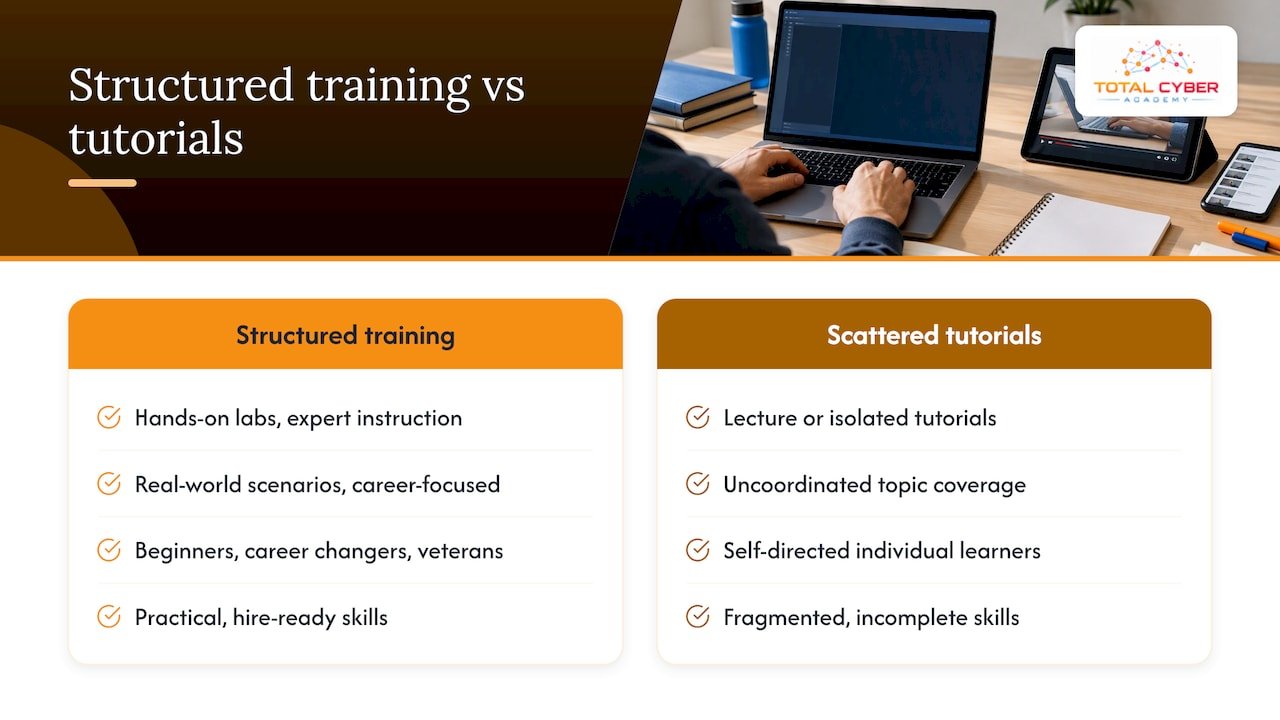
Total Cyber Academy is a veteran-owned training organization that builds hands-on labs, expert instruction, and real-world scenarios into its programs rather than relying on lecture alone. Its career-focused courses are designed to equip beginners, career changers, veterans, and IT professionals with practical skills, and course options such as the Burp Suite Basics course give newer learners a structured entry point into web application testing rather than a scattered set of tutorials.
A note on staying consistent through the slow stretch
Progress rarely feels linear. Some weeks you will plateau on a single box for days, then suddenly clear three in an afternoon.
The habit that matters most is a weekly documented writeup, shared privately with a mentor or redacted and posted publicly. It forces reflection, and reflection is what turns practice into a portfolio.
— Alden
Programs that can accelerate your roadmap
Self-study works, but it is slow without feedback, and the biggest risk for independent learners is practicing the wrong things for months before anyone tells them. Total Cyber Academy’s Penetration Tester Program is built around that gap: it maps directly to the labs, portfolio outputs, and interview preparation this roadmap describes, with instructor mentorship along the way.
- The Penetration Tester Program bundles methodology training, lab practice, and career support into one structured path.
- The CompTIA Pentest+ On-Demand Course supports the certification milestones covered earlier in this roadmap.
- Both are listed on the course catalog alongside other certification-prep options.
If you are ready to move past scattered tutorials, review the program details and see which track matches where you are in the roadmap.
Sources
The OWASP Web Security Testing Guide and NIST SP 800-115 cover methodology in depth, while the BLS Occupational Outlook tracks employment data.
- Information Security Analysts: Occupational Outlook Handbook — U.S. Bureau of Labor Statistics
- NIST SP 800-115: Technical Guide to Information Security Testing and Assessment
- securitycipher/penetration-testing-roadmap — GitHub
FAQ
What are the 7 stages of penetration testing?
Definitions vary across frameworks, but most describe four to seven stages covering planning, reconnaissance, scanning and enumeration, exploitation, post-exploitation, and reporting. The NIST SP 800-115 methodology groups these into a smaller set of testing phases rather than a fixed count of seven.
Will pentesters be replaced by AI?
Automated scanning tools already handle routine vulnerability detection, but the judgment needed to interpret findings, chain exploits, and communicate business risk remains a human task. Projected job growth of 29% for information security analysts through 2034, per the Bureau of Labor Statistics, suggests demand for these skills is increasing rather than shrinking.
How do I follow a pentester roadmap step by step?
Work through foundations in Linux and networking, then web security basics, then offensive methodology practice with labs and writeups, then a specialization, while pairing each phase with a relevant certification. Community-maintained roadmaps outline this same phase structure with reproducible lab outputs as the proof at each stage.
Is 30 too late to start a cybersecurity career?
No single age defines readiness for this field, and many successful testers start their technical training well into their thirties or later after a career change. What matters more is consistent practice time and a portfolio that demonstrates methodology and judgment, both of which can be built regardless of when you begin.