
Job-ready cybersecurity skills are the ones that let you contribute in the first weeks of a role: reading network traffic and logs, triaging alerts, hardening systems, writing up what you found, and working with a team under pressure. Hiring managers want proof that you can do this work, which means practice you can show, a recognized entry-level certification, and the soft skills that make you easy to train. This guide explains what that looks like, what a SOC analyst in particular needs, and how to build it, with extra notes for veterans.
TL;DR
- Employers weigh demonstrated ability above formal education: 89% of hiring managers would consider a candidate with only an entry-level certification, and 90% would consider one with only IT work experience.
- Teamwork, problem solving and analytical thinking top the list of skills hiring managers prioritize, ahead of data security and cloud security.
- For a SOC analyst role, the technical core is networking, operating systems, log and alert analysis, and clear incident documentation.
- Veterans can translate military experience into the NICE Framework’s shared vocabulary so recruiters and screening tools recognize it.
Table of Contents
- What “job-ready” means to a hiring manager
- The technical skills that carry the most weight
- Skills for a SOC analyst
- Soft skills are not a footnote
- Certifications: what they prove and what they do not
- How to build and prove the skills
- Our perspective
- For veterans: translate what you already have
- Where our training fits
- A realistic 90-day plan
- FAQ
- Sources
What “job-ready” means to a hiring manager
Job-ready does not mean expert. It means a manager can hand you a defined task and expect a competent result without weeks of supervision. That matters because training juniors is expensive: in the 2025 ISC2 hiring research, 45% of hiring managers said it takes 4 to 9 months for a junior team member to work independently. Every month you can remove from that ramp makes you a lower-risk hire.
The same research shows what managers expect juniors to handle on day one. According to the ISC2 2025 Cybersecurity Hiring Trends Report, 53% of hiring managers expect junior professionals to handle intrusion detection. That is a concrete, learnable skill, and it is exactly what a hands-on lab can rehearse before you apply.
Three things together signal readiness:
- Applied technical fundamentals, shown through labs, projects and exam results.
- A recognized certification that maps to the job you want.
- Working habits such as documentation, communication and steady problem solving.
The technical skills that carry the most weight
No single list covers every role, but a short set of fundamentals appears in nearly every entry-level security job description.
Networking
You cannot investigate activity you cannot read. Learn how TCP/IP, DNS, HTTP and HTTPS behave normally, what ports and protocols common services use, and how firewalls, VPNs and segmentation shape traffic. Practice with a packet capture tool until a normal DNS lookup and a suspicious one look different to you.
Operating systems
Be comfortable in both Windows and Linux: users and permissions, services and processes, the registry or configuration files, scheduled tasks, and where each system writes its logs. Most investigations come down to asking what changed on a machine and who changed it.
Logs, alerts and detection
Security teams live in logs. Learn to search them, filter noise, follow an alert back to the raw events, and decide whether it is benign, suspicious or a real incident. Working in a SIEM, the platform that collects and correlates log data, is the closest thing to a daily routine for many entry-level analysts.
Security fundamentals
Know the core concepts well enough to explain them plainly: confidentiality, integrity and availability, least privilege, authentication and access control, common attack types such as phishing and credential theft, and the basics of vulnerability management and risk.
Scripting and automation
You do not need to be a software developer. You do need to read a short script, and ideally write simple ones in Python or PowerShell to parse a log file or repeat a task. It separates candidates who click through tools from those who can extend them.
Cloud awareness
Most organizations run workloads in the cloud, so basic knowledge of identity, storage and logging in a major provider helps. If this is a gap, our guides on cloud security skills for beginners and entry-level cloud certifications show where to begin.
Skills for a SOC analyst
The security operations center is where many organizations hire their first-career analysts, so it is a sensible target. A Tier 1 analyst watches alerts, investigates the suspicious ones, and escalates real incidents. The skills map directly to the fundamentals above.
| SOC task | Skill behind it | How to practice |
|---|---|---|
| Triage an alert | Networking, OS knowledge, reading logs | Investigate sample alerts and decide benign or malicious |
| Detect intrusions | Understanding of attacker behavior and normal baselines | Run guided intrusion-detection labs |
| Search and correlate data | SIEM queries, filtering, timelines | Build searches in a lab SIEM |
| Escalate and document | Clear writing, accurate timelines | Write a short incident report for every lab |
| Work a shift with others | Teamwork, communication, calm under pressure | Join team exercises and capture-the-flag events |
Two habits distinguish strong junior analysts. They write down what they checked and why, so the next person can pick up the case, and they know when to escalate instead of guessing. Both are teachable, and both come up in interviews.
Soft skills are not a footnote
Candidates are often surprised by this finding. The ISC2-based reporting from TechRepublic lists teamwork, problem solving and analytical thinking as the top three skills managers prioritize for cybersecurity roles, above data security and cloud security. Computerworld’s coverage of the same study notes that many organizations now put soft skills and varied backgrounds ahead of technical depth for a number of IT roles.
The practical consequence: show these skills, do not just claim them.
- Teamwork: describe a group lab, competition or project and your specific role in it.
- Problem solving: walk through one investigation from first symptom to conclusion, including a wrong turn.
- Analytical thinking: explain how you ruled hypotheses in or out.
- Professional presence: the ISC2 findings also note that over 50% of hiring managers have passed on candidates because of their social media activity, so review your public profiles before you apply.
Certifications: what they prove and what they do not
An entry-level certification tells a manager you have covered a defined body of knowledge and passed a proctored exam. In the ISC2 research, 47% of managers rank certifications above formal education, against 43% for education. It is not a guarantee of skill, which is why the strongest candidates pair it with lab work.
For most newcomers the sequence is straightforward:
- CompTIA A+ or Network+ if you need IT and networking foundations.
- CompTIA Security+ as the common first security credential.
- CompTIA CySA+ once you want to move toward analyst work and detection.
- EC-Council CEH for those leaning toward offensive security and penetration testing.
If you are unsure where to start, our first cybersecurity certification guide with an 8 to 12 week plan lays out the order, and the prerequisites checklist shows what to know before you enroll.
Do not be discouraged by job postings that ask for advanced credentials. Computerworld notes that some entry-level listings demand the CISSP or CISA, which each require five years of professional experience, and that these listings often do not reflect the actual requirements of the role. Apply anyway if the day-to-day tasks fit.
How to build and prove the skills
1. Pick a target role and read real postings
Choose one role, such as SOC analyst, and read ten current job postings. Highlight repeated tools, tasks and certifications. That list is your curriculum. Our overview of entry-level cybersecurity jobs describes what to expect from each starting role.
2. Practice in labs, not only in videos
Reading about a log source is not the same as parsing a thousand lines of it. Hands-on environments let you make mistakes safely and build the muscle memory managers are looking for. Our piece on practical cybersecurity experience covers ways to create experience when you have no job history in the field.
3. Keep a portfolio
For each lab or project, keep a one-page write-up: the scenario, your method, what you found, and what you would do next. Five clear write-ups beat a long list of tool names.
4. Use earn-and-learn routes where they exist
Internships and apprenticeships are valued by managers: the ISC2 findings describe internships (55%) and apprenticeships (46%) as strong ways to find early-career talent. The U.S. Department of Labor says Registered Apprenticeships give veterans an earn-and-learn pathway with pay from day one. Read our explainer on how a cybersecurity apprenticeship works to see how to start.
5. Learn the shared vocabulary
The NICE Framework from NIST sets a standard approach and common language for describing cybersecurity work and learner capabilities. Use it to describe your skills in terms a recruiter recognizes.
Our perspective
We see the same pattern in new students again and again. People arrive believing they need to master every tool before applying, or that a certificate alone will open doors. Neither is quite right. The students who move fastest combine a certification with proof they have done the work: labs completed, incidents written up, questions asked of working practitioners.
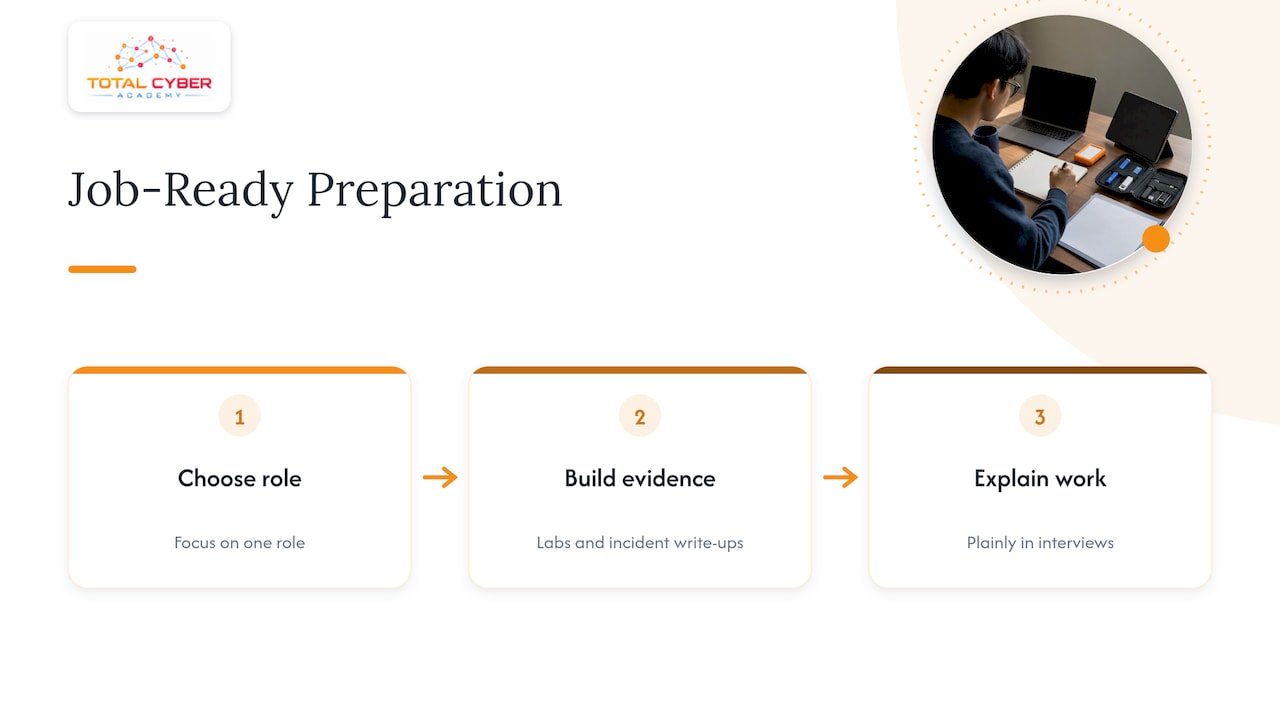
That is why we teach for the job and not only for the exam. Exam preparation matters, since the credential gets your résumé through the first screen. But a manager who asks how you would investigate a suspicious login wants a method, not a definition. Our training pairs certification preparation with practical labs, live tutoring and mentorship from active cybersecurity professionals, because those are the habits that shorten the ramp-up period employers worry about.
Our advice is to choose one role, build a small body of evidence, and talk about it plainly in interviews. Confidence comes from having done the work, and employers can hear the difference.
— Alden
For veterans: translate what you already have
Military service builds many of the traits hiring managers say they want. The NICCS cybersecurity guide for veterans notes that service members are trained to maintain situational awareness, learn on the job, make security decisions and respond to changing conditions. The Department of Labor’s employer guide describes veterans as adaptable contributors with strong performance under pressure.
The task is translation:
- Map your experience to NICE work roles. NICCS advises veterans to match their military tasks, knowledge and skills to the NICE Framework, which aligns your background with the language recruiters and screening tools use. Start at the NICCS veterans resources.
- Highlight clearances. An active security clearance can speed hiring for federal, contractor and intelligence community roles.
- Use transition programs. The DoD SkillBridge program allows training and work experience during the final 180 days of service, according to the Department of Labor guide. See our SkillBridge guide for veterans and explainer on SkillBridge cybersecurity training. Eligibility and approval vary, so confirm with your installation’s transition office.
Where our training fits
Total Cyber Academy is a veteran-owned training organization built around hands-on labs, exam preparation, live mentoring and veteran support. If you want structure, these are the options most relevant to job-ready skills:
- CompTIA Security+ SY0-701: $2,499.99 on demand or $2,999.99 as a live course.
- CompTIA CySA+ v3: $2,499.99 on demand or $2,999.99 live, aimed at analyst work.
- CompTIA Network+ (009): $2,499.99 on demand, $2,999.99 live.
- CompTIA A+ 220-1201 or 220-1202: $1,999.99 each on demand.
- EC-Council CEH: $2,999.99 on demand or $3,499.99 live.
Browse the full course catalog or look at our career programs for Cybersecurity Engineer, Penetration Tester, IT Operations Specialist and Cloud Engineer paths. For help choosing, start with our beginner’s guide to cybersecurity training or contact us through Total Cyber Academy.
A realistic 90-day plan
This outline assumes about ten hours a week. Adjust it to your schedule and starting point.
- Days 1 to 30, foundations. Study networking and operating system basics. Capture and read your own network traffic. Build a home lab with a Windows and a Linux virtual machine.
- Days 31 to 60, security core. Work through Security+ objectives alongside labs on authentication, malware behavior and vulnerability scanning. Write up two investigations.
- Days 61 to 90, role focus. Practice alert triage and log searches, add a simple script, and schedule your exam. Update your résumé using NICE Framework language and start applying.
Expect to apply widely and to hear back from some employers slowly. The hiring research is encouraging on one point: 75% of hiring managers planned to grow their security teams in 2025, and 91% provide ongoing professional development, so a willingness to learn counts for a great deal.
FAQ
Do I need a degree to get a cybersecurity job?
Not necessarily. In the ISC2 research, most managers would consider candidates with only IT work experience or only an entry-level certification. A degree still helps for some employers and roles, so check postings in your target field. Our guide on choosing between an associate degree and a certificate compares the paths.
What skills does a SOC analyst need most?
Networking fundamentals, Windows and Linux knowledge, log and alert analysis, familiarity with a SIEM, and clear written escalation. Add teamwork and calm judgment, since analysts work shifts and hand cases to one another.
How long does it take to become job-ready?
It depends on your starting point and hours available. Someone with IT experience may be ready in a few months, while a complete beginner should plan for longer. The more of your study time you spend in labs, the more convincing your evidence will be.
Is a certification enough on its own?
It helps you get past screening, and many managers will consider it without experience. Pair it with a portfolio of lab write-ups so you can show what you can do, not only that you passed an exam.
Sources
- ISC2 2025 Cybersecurity Hiring Trends study (ISC2 China)
- 2025 Cybersecurity Hiring Trends Report, CyberSecurityStats.com
- Top 5 Skills Entry-Level Cybersecurity Professionals Need, TechRepublic
- College grads face a chaotic IT job market, Computerworld
- Cybersecurity for Veterans, NICCS
- Employer Guide for Hiring Veterans, U.S. Department of Labor
- Apprenticeship, U.S. Department of Labor
- Getting Started with the NICE Framework, NIST