The best cybersecurity capstone is a project you can scope to your timeline, test against real attacker behavior, and document the way a security team would. Pick a topic that matches a job you want, build something measurable, and map it to a recognized framework. This guide lists specific ideas by difficulty, explains how to turn each one into a portfolio piece, and covers what veterans and career changers should emphasize.
TL;DR
- Match the project to your time: beginner projects run roughly 2 to 4 weeks, intermediate 4 to 6, and advanced 6 to 10.
- Do not just build a tool. Test it against known attacker tactics and map it to MITRE ATT&CK or NIST CSF 2.0.
- Documentation (threat model, risk assessment, policy rationale) is what separates a class assignment from professional-grade work.
- Veterans should pick topics that echo their service, such as critical infrastructure defense or threat hunting.
Table of Contents
- What a cybersecurity capstone is supposed to prove
- How to choose a capstone topic
- Beginner ideas (about 2 to 4 weeks)
- Intermediate ideas (about 4 to 6 weeks)
- Advanced ideas (about 6 to 10 weeks)
- Emerging-technology ideas
- Test it against attacker behavior, not just your own assumptions
- Do not skip the documentation
- Capstone ideas for veterans
- Our perspective on capstones
- Building the skills your capstone needs
- A simple plan for the next six weeks
- FAQ
- Sources
What a cybersecurity capstone is supposed to prove
A capstone is the final project of a degree, bootcamp, or training program. Its job is to show that you can apply what you studied to a realistic problem. A Georgia Tech practicum syllabus describes it as work on a real-world cybersecurity problem that offers “in-context” learning, and that is a useful standard for any capstone, whether or not your program is a university one.
Hiring managers rarely care whether your project was novel. They care whether it shows how you think. A project that detects, contains, and reports on an incident tells them more than a clever tool with no evidence behind it.
How to choose a capstone topic
Use four filters before you commit.
- Time. Be honest about your calendar. A half-finished machine learning detector is worth less than a finished, well-tested SIEM lab.
- Target role. A SOC analyst role calls for detection and response work. A penetration testing role calls for an assessment with findings and remediation. A cloud role calls for configuration review and hardening.
- Frameworks. Practitioners say projects are most impactful when they map to frameworks like MITRE ATT&CK or NIST CSF 2.0, because that shows you can tie security controls to organizational resilience instead of building isolated tools.
- Evidence. Decide up front what you will measure: detection rate, false positives, time to contain, number of misconfigurations found.
Beginner ideas (about 2 to 4 weeks)
These suit students finishing an entry-level certification such as Security+ or Network+. The timeline guidance points to basic tools like firewalls and password managers at this level.
- Home network firewall and segmentation lab. Build a small virtual network with a firewall, a DMZ, and an internal segment. Write rules, test them with a scanner, and document what each rule blocks and why.
- Password policy audit and manager rollout plan. Create a mock organization, analyze its password risks, and propose a policy with a rollout plan. Add a password strength analyzer if you want a coding component.
- Phishing awareness simulation (in a lab only). Design a simulated campaign against test accounts you own, measure click rates, and write a training summary. Keep it inside a lab with explicit consent rules.
- Secure small-office Wi-Fi review. Assess a lab router’s configuration, apply hardening steps, and show before-and-after scan results.
A public project list for beginners puts typical beginner work at 1 to 4 weeks, so you can see the range is consistent across sources.
Intermediate ideas (about 4 to 6 weeks)
Here you move from configuring controls to detecting and responding.
SIEM dashboard with detection rules
Stand up an open-source SIEM, forward logs from a Windows and a Linux host, and write detections for failed logins, new admin accounts, and suspicious PowerShell. Then run simulated attacker behavior and record which detections fired. Map each rule to a MITRE ATT&CK technique and publish the mapping as a table.
Network scanner and vulnerability prioritization report
Scan a lab environment, rank findings by exploitability and business impact, and write a remediation plan. One university team built an AI-assisted vulnerability analysis tool for a security company to help its analysts sift through large volumes of findings. You do not need AI to do a smaller version: a scoring spreadsheet with a clear method is a legitimate project.
Incident response tabletop and playbook
Write a ransomware playbook for a fictional 50-person company, run a tabletop with classmates or mentors, and document decisions, timing, and gaps. This is cheap, fast, and directly relevant to how teams work.
Web application assessment against the OWASP Top 10
Test a deliberately vulnerable application, document each finding, and propose code-level fixes. The project guidance recommends integrating standard frameworks like the OWASP Top 10 so the work reads as industry-relevant.
Advanced ideas (about 6 to 10 weeks)
Advanced work suits students with a solid foundation in networking, scripting, and an intermediate certification such as CySA+ or CEH. The same timeline guide lists machine learning intrusion detection, ransomware analysis, and blockchain security as typical advanced topics.
- Machine learning intrusion detection. Train a classifier on a public network dataset, then test it against traffic you generate. Report precision, recall, and the cases where it failed. Failure analysis is what makes this credible.
- Ransomware behavior analysis. Detonate samples in an isolated sandbox, document file system, registry, and network behavior, and write detection logic and a response checklist.
- Automated incident response for critical infrastructure. Build a workflow that isolates a host, preserves evidence, and notifies responders when a rule triggers. Capstone idea lists for 2026 to 2027 include this alongside IoT honeypot networks and privacy-preserving data sharing with differential privacy.
- IoT deception network. Deploy honeypots that mimic smart devices, collect attacker interactions, and classify them by technique.
- Purple team exercise. Run a red team simulation against your own blue team lab, then improve detections based on what was missed. This mirrors the way CISA’s analysis of two red team assessments evaluates monitoring, and its advice to establish baselines and reduce alert noise gives you concrete metrics to chase.
Emerging-technology ideas
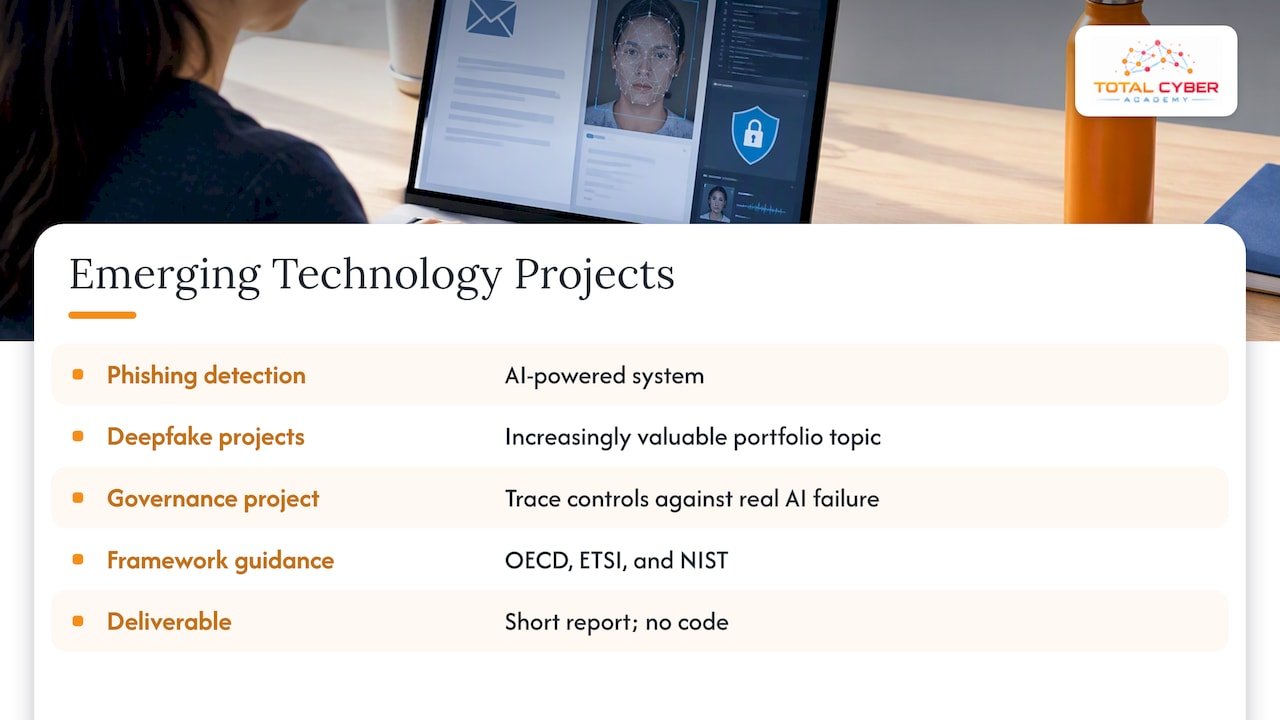
Topics around AI are attractive because employers are still working out how to secure them. The same 2026 to 2027 topic list suggests an AI-powered phishing detection system and says projects on deepfake detection and attribution are increasingly valuable for a portfolio.
A governance angle works well here. You could take a real AI failure and trace which controls should have caught it, using a write-up on AI incident reporting frameworks that maps OECD, ETSI, and NIST guidance to real failures as a starting point. The deliverable is a short report with a control gap table, not code, which makes it a good fit for career changers who come from compliance, audit, or operations.
Test it against attacker behavior, not just your own assumptions
People who work in security operations say the goal of a capstone is to replicate a realistic incident environment. CISA’s assessment of two security operations centers is a good model for the mindset: it looks at how monitoring held up against real attacker behavior and what baselines were missing.
Apply that to your own work:
- Pick five to ten ATT&CK techniques relevant to your scenario.
- Simulate each one in your lab.
- Record whether your tool or control detected, blocked, or missed it.
- Fix the misses and rerun.
- Present the before-and-after results.
A table of techniques with detected, missed, and fixed columns is easy to read in an interview and hard to fake.
Do not skip the documentation
Students tend to spend nearly all their time on implementation. NIST’s work on the cybersecurity talent gap, including its employer-focused project materials, is a reminder that employers want to build their own early-career pipelines, which means they are reading junior portfolios closely. Mentors who work with the NICE Framework stress that technical work without a risk assessment, threat model, and policy justification is rarely seen as professional grade in sectors like defense and critical infrastructure.
A solid capstone package includes:
- A one-page executive summary written for a non-technical manager.
- A scope and threat model, with assumptions stated.
- A risk assessment with likelihood and impact ratings.
- The technical build, with diagrams and configuration notes.
- Test results mapped to ATT&CK or NIST CSF 2.0.
- Lessons learned and what you would do with more time.
Capstone ideas for veterans
If you served, your best capstone is one that makes your background legible to a civilian hiring manager. NIST’s career resources for veterans point to NICE Framework-aligned training pathways, and CISA’s NICCS guidance for veterans offers tools to map military experience, skills, and knowledge to cybersecurity work roles. Use that mapping to choose your topic.
| If your background is | Consider a capstone on |
|---|---|
| Signals, communications, or network operations | Network segmentation and monitoring for a mock defense contractor |
| Intelligence or analysis | Threat hunting project using ATT&CK, with a hunt report |
| Logistics or base operations | Supply chain risk assessment for a critical infrastructure operator |
| Command, planning, or leadership | Incident response playbook and tabletop exercise |
| Infantry, maintenance, or other non-IT roles | Physical and cyber security review of an IoT-connected facility |
Mentors suggest topics like defending critical infrastructure or conducting threat hunting because they line up directly with defense-related cybersecurity roles. In your write-up, state the parallel explicitly: the chain of command became an escalation matrix, the after-action review became the lessons-learned section.
For more on translating service into a civilian résumé, see our guides on military skills in IT careers and GI Bill cybersecurity training programs.
Our perspective on capstones
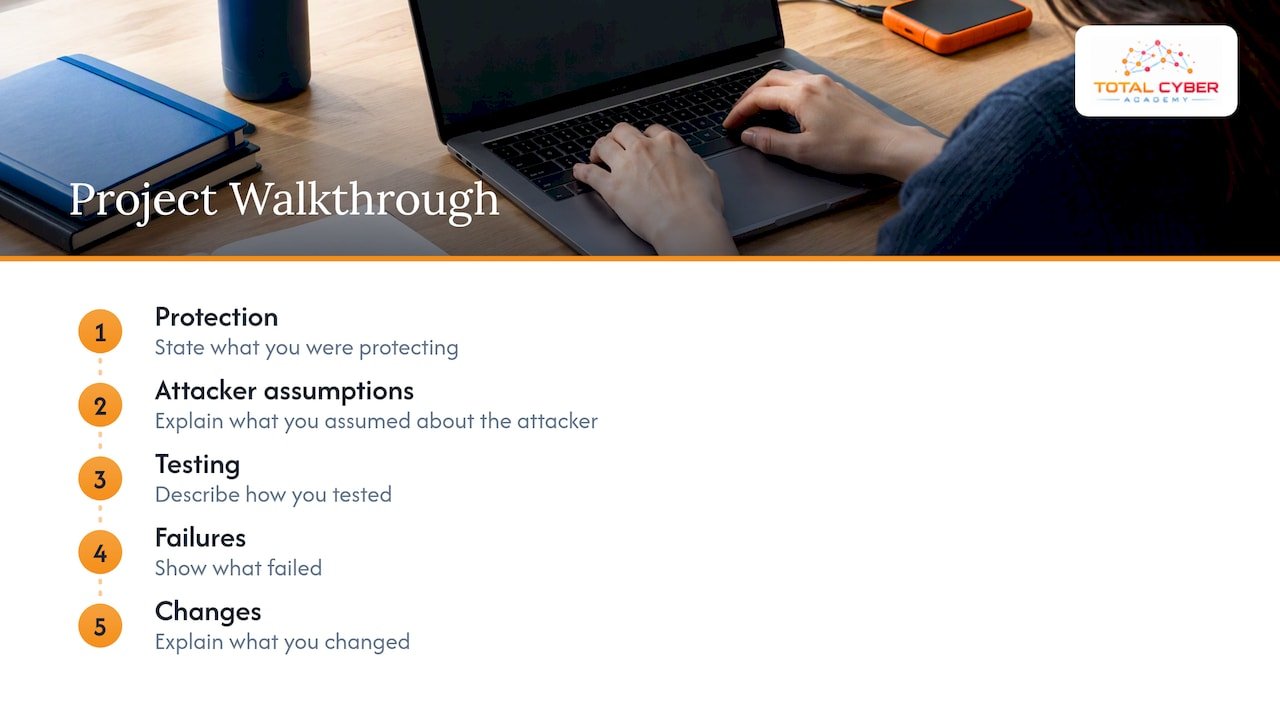
We teach people who are changing careers, and we see the same pattern. The students who get interviews are rarely the ones with the flashiest tool. They are the ones who can walk through a project end to end: what they were protecting, what they assumed about the attacker, how they tested, what failed, and what they changed.
That is why our training puts hands-on labs and real-world scenarios ahead of exam-only preparation. Certifications open doors, but a project you can explain in ten minutes keeps the conversation going. We also encourage students to use live tutoring sessions and mentors who work in the field to pressure-test a project before an employer does. Ask a practitioner to try to break your assumptions. It is the cheapest and fastest quality check available.
Our advice for veterans in particular: do not hide your service behind generic project topics. Pick a problem that sounds like your old mission, and say so.
— Alden
Building the skills your capstone needs
A capstone is easier when the underlying skills are solid. If you are building a detection lab, the CompTIA Security+ SY0-701 material covers the control and incident response concepts you will apply. Our Security+ On-Demand course is $2,499.99 and the Live course is $2,999.99, both one-time payments. For attack-side projects, the EC-Council CEH On-Demand course is $2,999.99, and CySA+ v3 On-Demand, which fits SOC-style detection work, is $2,499.99.
If you want a structured path that ends in project work, look at our career programs, including the Cybersecurity Engineer and Penetration Tester programs. Not sure where to begin? Read our prerequisites checklist first.
A simple plan for the next six weeks
- Week 1: Choose the topic, write a one-page scope, and name the framework you will map to.
- Weeks 2 to 3: Build the core lab or tool. Keep notes as you go, not afterward.
- Week 4: Run attacker-behavior tests and log results.
- Week 5: Fix gaps, rerun tests, and write the risk assessment.
- Week 6: Produce the executive summary, a short demo video, and a public repository with a clean README. Strip any sensitive data and keep all testing inside systems you own.
FAQ
What are some good cybersecurity capstone project topics?
Good topics are ones you can finish and measure: a SIEM with ATT&CK-mapped detections, a vulnerability prioritization report, an incident response playbook with a tabletop, or a machine learning intrusion detector with honest failure analysis. Choose the one closest to the role you want.
How long should a cybersecurity capstone take?
It depends on difficulty. One project guide suggests 2 to 4 weeks for beginner work, 4 to 6 for intermediate, and 6 to 10 for advanced. Your program may set its own schedule, so check it first.
Do I need to write code for a capstone?
Not always. Governance, risk assessment, incident response planning, and configuration hardening projects can be strong without custom code. Code helps for detection and automation roles, but clear methods and evidence matter more than lines written.
How can a veteran make a capstone stand out?
Choose a topic that mirrors your service, such as threat hunting or critical infrastructure defense, and explain the connection in plain language. Map your military experience to NICE Framework work roles using NICCS tools, then show the same skills in your project.
Sources
- 200+ Cyber Security Project Ideas, CodeSelf Projects
- 100+ Cybersecurity Project Ideas, Hack Hint
- Cybersecurity Capstone Project Topics & Ideas, ns3simulation
- A Tale of Two SOCs, CISA
- Employer Project for MTM, NIST
- Cybersecurity Career Resources for Veterans, NIST
- Cybersecurity for Veterans, NICCS
- CS6727 Cyber Security Practicum syllabus, Georgia Tech
- Cyber Recon final capstone report, Northern Arizona University