
The ethical hacking certifications worth your time fall into three tiers: foundation credentials (CompTIA Security+, Network+), mid-level offensive credentials (CEH, CompTIA PenTest+) and advanced hands-on exams (OSCP, GIAC penetration testing certifications, eCPPT). Which one to earn first depends on your experience, your budget and whether the job you want screens résumés by keyword or tests you at a keyboard. This list covers each credential, what it proves, what it costs where we could verify a price, and how veterans can get the exam fee reimbursed.
TL;DR
- Start with Security+ or Network+ if you have no IT background. Most offensive certifications assume you already understand networks, operating systems and basic security controls.
- CEH and PenTest+ are the usual mid-level choices. CEH is the most recognized name on job postings, while PenTest+ and the OSCP lean harder on practical skill.
- Hands-on, proctored lab exams such as the OSCP carry the most weight with technical hiring managers, but they are the hardest to pass.
- Veterans can use the GI Bill to be reimbursed for up to $2,000 per certification test, though not for the prep course itself unless it sits in an approved program.
- Training and certification are separate. Finishing a class does not make you certified; you still have to sit and pass the exam.
Table of Contents
- How to read this list
- The list at a glance
- Foundation certifications: where most people should begin
- Mid-level certifications for aspiring ethical hackers
- Advanced certifications: proving you can do the work
- Which certification should you earn first?
- What our team thinks about certification lists
- Protect your own accounts while you learn
- Paying for exams with the GI Bill
- Training for the exams with Total Cyber Academy
- Frequently asked questions
- Sources
How to read this list
Certifications differ in two ways that matter more than the logo on the badge. The first is what the exam measures: some test what you know through multiple-choice questions, others make you break into machines inside a time limit. The second is who recognizes it: some credentials satisfy government and contractor hiring rules, others are respected mainly by practitioners.
Industry voices quoted by Security Boulevard make the same point: all certifications show dedication, but they are not equal in difficulty or real-world application, and entry-level credentials work best as building blocks. That is a useful frame for the rest of this page. Pick a credential for the job it opens, then pick the next one for the skill it adds.
The list at a glance
| Tier | Certification | Exam style | Best for |
|---|---|---|---|
| Foundation | CompTIA Security+ | Multiple choice plus performance-based questions | Anyone entering cybersecurity |
| Foundation | CompTIA Network+ | Multiple choice plus performance-based questions | Learning how traffic moves before you attack it |
| Mid-level | EC-Council CEH | Knowledge-based exam on attack techniques and tools | Recognition on job postings, government-adjacent roles |
| Mid-level | CompTIA PenTest+ | Multiple choice plus performance-based questions | First penetration testing credential |
| Mid-level | CompTIA CySA+ | Multiple choice plus performance-based questions | Defenders who need to think like attackers |
| Advanced | OffSec OSCP | Practical lab exam | Working penetration testers |
| Advanced | GIAC penetration testing credentials (such as GPEN) | Proctored exam, open book | Professionals whose employers fund advanced training |
| Advanced | eCPPT, Burp Suite Certified Practitioner | Practical assessments | Network and web application specialists |
The CSO Online roundup of 16 offensive security certifications also lists credentials such as Certified Penetration Testing Engineer, Certified Red Team Expert and GIAC Cloud Penetration Tester, which are worth a look once you specialize.
Foundation certifications: where most people should begin
CompTIA Security+
Security+ covers threats, vulnerabilities, cryptography, identity management and incident response. It is not an ethical hacking exam, but it teaches the vocabulary every later exam uses. It is also the most common baseline requirement in entry-level security job postings, which is why many career changers and transitioning service members start here. Our first cybersecurity certification guide lays out an 8 to 12 week plan for it and three other beginner credentials.
CompTIA Network+
You cannot exploit what you do not understand, and almost every attack path crosses a network. Network+ covers addressing, routing, switching, wireless and troubleshooting. If you have never configured a subnet, take this before an offensive exam and your lab time will go much further.
Other entry points
Free and low-cost options exist. ISC2 has offered free Certified in Cybersecurity training and exams through a one-million-people program, which is a no-risk way to test your interest. Our review of the Google Cybersecurity Certificate covers another low-cost route and what it does and does not prove to employers.
Mid-level certifications for aspiring ethical hackers
Certified Ethical Hacker (CEH)
CEH, issued by EC-Council, is the credential most people mean when they search for ethical hacking certifications. It covers reconnaissance, scanning, system hacking, malware, web application attacks, wireless attacks and cloud security, using the tools attackers use. Its main strength is recognition: it appears on more job descriptions than any other offensive credential, and it is frequently named in government and contractor requirements.
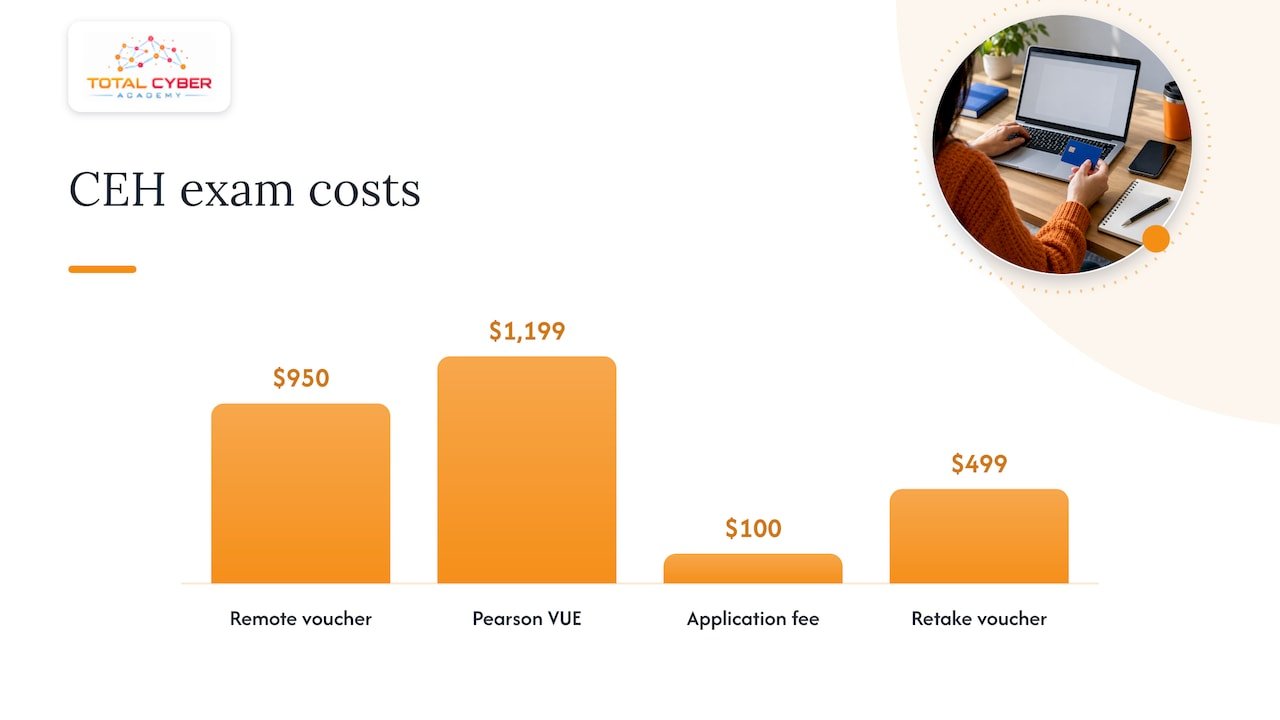
Costs are the question readers ask most. According to a 2026 cost breakdown, the CEH voucher runs $950 with EC-Council remote proctoring or $1,199 at a Pearson VUE testing center, plus a $100 application fee if you skip official training and cannot document two years of security experience. A retake voucher is listed at $499. Check EC-Council’s own page before you buy, because exam pricing changes.
Is it hard? It is a long, knowledge-heavy exam that rewards people who have actually used the tools, so labs matter more than memorizing lists. It is easier than a practical exam such as the OSCP, but it is not a pushover for someone with no networking background.
CompTIA PenTest+
PenTest+ covers planning and scoping an engagement, information gathering, vulnerability scanning, attacks and exploits, reporting, and tooling. The reporting and scoping content is its quiet advantage: real penetration tests are won or lost on clear findings and legal boundaries, not only on exploits. It includes performance-based questions, so it sits closer to practical skill than a pure multiple-choice test, and it pairs naturally with Security+ and Network+.
CompTIA CySA+
CySA+ is a defensive analyst credential, but ethical hackers who understand detection write better reports and evade fewer alarms by accident. It is a strong choice if your target job is in a security operations center and you want offensive knowledge as a second skill.
Advanced certifications: proving you can do the work
OffSec Certified Professional (OSCP)
The OSCP is the credential practitioners respect most. You are given a network of machines and a time limit, and you must compromise them and document how. There is no way to bluff it. Expect months of lab practice before attempting it, and expect to fail once if you rush. Our guide to OffSec training for aspiring pentesters explains the path and the prerequisites in more detail.
GIAC penetration testing credentials
GIAC certifications such as GPEN are well regarded and often paid for by employers, because the associated training is expensive. Advanced GIAC levels and OffSec’s expert-level exams sit at the top of the difficulty scale, with the exploit development and research credentials generally ranked hardest in the Security Boulevard ranking.
Specialist practical exams
The Burp Suite Certified Practitioner proves web application testing skill, and eCPPT is a practical network penetration testing exam. They are good second or third credentials once you know which kind of testing you enjoy. Our roundup of six hands-on penetration testing certifications for every career stage maps these to experience levels.
Which certification should you earn first?
Use your starting point, not the ranking, to decide.
- No IT experience: Security+ first, then Network+. Use the time to build a home lab.
- Some help desk or network experience: Security+ or PenTest+, then CEH if your target employers ask for it by name.
- Already in security and want to move into offensive work: CEH or PenTest+ to cover the breadth, then the OSCP to prove depth.
- Targeting federal or contractor work: check the job posting and the relevant requirements first, since some roles name specific credentials.
If you are unsure how much preparation any of these demands, our cybersecurity training prerequisites checklist and the certification roadmap help you plan the order.
What our team thinks about certification lists
We train people for these exams, and we still say a list like this one is only half the answer. The other half is whether you can do something with the credential on the first day of the job.
In our experience, students who pass an exam with only memorized material struggle in interviews, because interviewers ask them to walk through how they would test a system. Students who spent their study time in labs, breaking and fixing machines, answer those questions without notes. That is why we build our courses around practical labs, live tutoring and mentoring from active cybersecurity professionals rather than exam cramming alone. If you want to see what that looks like in practice, read what we mean by hands-on cybersecurity training.
Our advice for veterans and career changers is simple. Choose one credential that matches a job you can name, build lab evidence alongside it, and treat every later certification as an upgrade to a skill you already use.
— Alden
Protect your own accounts while you learn
Ethical hackers collect sensitive material: scan results, client credentials, lab notes and cloud keys. Securing your own accounts is a professional habit, and strong multifactor authentication is part of it. Phishing-resistant hardware security keys for strong multifactor authentication are one option for protecting email, cloud and code accounts that hold testing data. Practice only on systems you own or have written permission to test, such as a properly isolated lab. Our pentesting lab setup guide shows how to keep that environment safe.
Paying for exams with the GI Bill
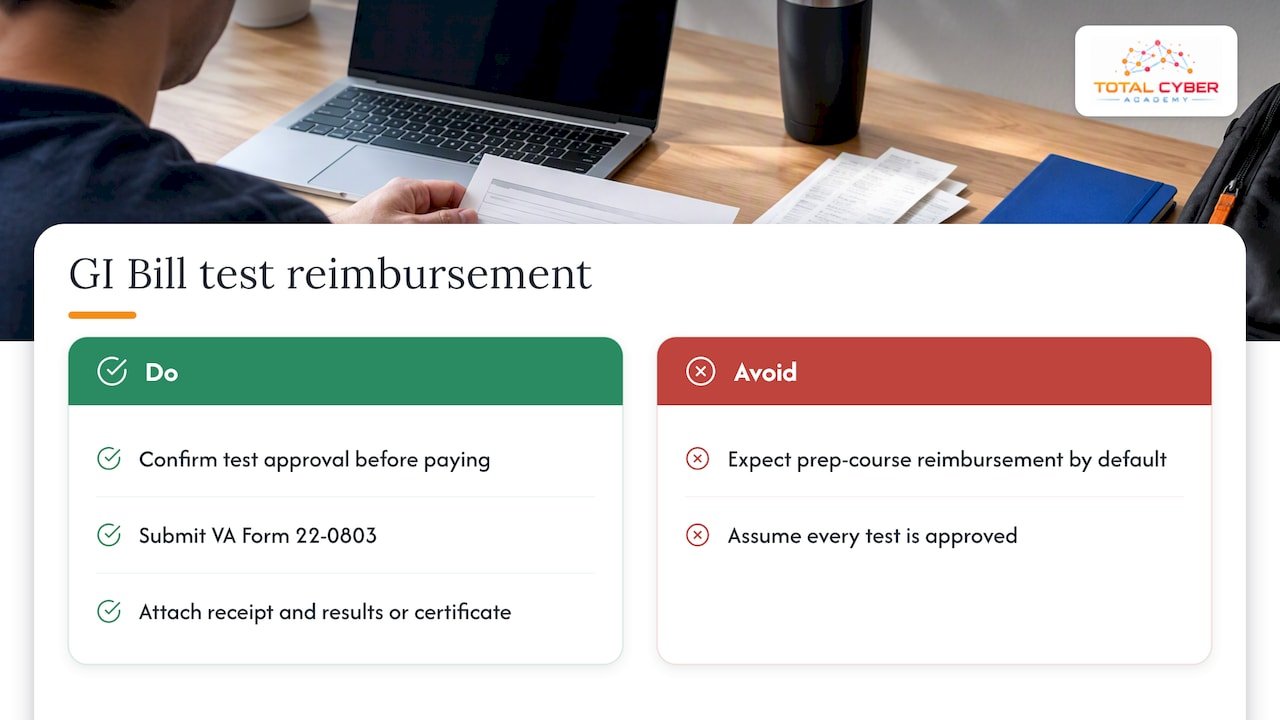
Eligible veterans can be reimbursed for approved licensing and certification tests. The VA states that the benefit pays no more than $2,000 per test, and it applies even if you do not pass or if you retake a test for recertification. You apply with VA Form 22-0803, a copy of your receipt and your test results or certificate.
Two cautions. First, the reimbursement covers the test fee, not a prep course, unless that course is part of a specifically approved institutional program. Second, confirm that your exact test is approved before you pay. The VA fact sheet on licensing and certification test reimbursement describes what qualifies, including computer network roles. Our GI Bill cybersecurity training guide and the Army COOL roadmap walk through the process for service members.
Training for the exams with Total Cyber Academy
We are a veteran-owned academy, and we teach toward the certifications on this list through instructor-led and on-demand courses with labs, practice quizzes and mentoring. Published prices as of our last site check:
| Course | Format | Price |
|---|---|---|
| CompTIA Security+ SY0-701 | Live | $2,999.99 |
| CompTIA Security+ 701 | On-demand | $2,499.99 |
| CompTIA Network+ (009) | On-demand | $2,499.99 |
| CompTIA CySA+ v3 | On-demand | $2,499.99 |
| EC-Council CEH | On-demand | $2,999.99 |
| EC-Council CEH | Live | $3,499.99 |
See the full lineup on our course catalog, read about the live CEH course, or look at our career programs, including the Penetration Tester Program, if you want a structured path from first lab to job search. Remember that an exam voucher is a separate purchase from training.
Frequently asked questions
What certifications should I get for ethical hacking?
For most beginners, Security+ and Network+ come first, followed by CEH or PenTest+. Experienced practitioners then add a hands-on credential such as the OSCP. Match the choice to job postings in the role you want.
How much does a CEH cert cost?
The exam voucher is listed at $950 for remote proctoring or $1,199 at a Pearson VUE center, plus a $100 application fee if you self-study without qualifying experience. Training is extra and varies by provider and format. Always confirm current pricing with EC-Council before purchasing.
Is CEH a hard exam?
It is demanding because of its breadth, covering many attack types and tools, but it is a knowledge-based exam and generally easier than a practical lab exam like the OSCP. Candidates with solid networking basics and plenty of lab time tend to be better prepared than those who only read. Our guide on how to study for IT certification exams covers a method that works.
Can I go to jail for hacking?
Yes, if you access computer systems without authorization, even with good intentions. Ethical hacking is legal only with explicit permission, ideally a written scope from the system owner. Practice in your own lab or on platforms that invite testing, and ask an attorney if you are unsure about a specific engagement.
Sources
- Licensing and Certification Tests and Prep Courses, U.S. Department of Veterans Affairs
- VA Licensing and Certification Test Reimbursement Fact Sheet
- Top 10 Hacking Certifications, Security Boulevard
- Top 16 OffSec, pen-testing, and ethical hacking certifications, CSO Online
- CEH Certification Cost 2026, Unihackers
- Free Entry-level Cybersecurity Training and Certification Exam, ISC2