
CEH is worth it if you need an HR-recognized credential, your employer covers the cost, or a target role lists it by name; it rarely substitutes for hands-on proof once you reach technical interviews. Information security analyst jobs are projected to grow much faster than average from 2024 to 2034, and some government billets check it against the DoD 8140 qualification matrix. Use the checklist below to confirm where you stand before you pay for a voucher.
TL;DR:
- CEH is most valuable when your target role explicitly lists it or if your employer funds the certification process.
- The knowledge exam costs around $1,199 and requires 6 to 10 weeks of study, with ongoing renewal every three years.
- It mainly filters HR and automated screening, but technical managers prefer hands-on proof through labs, CTFs, or project portfolios.
- For DoD or government roles, verify your specific position against the latest DoD 8140 matrix, as CEH may not always qualify directly.
- Practical experience and documented projects provide more value than CEH alone when applying for advanced or senior cybersecurity roles.
Table of Contents
- What CEH Covers and How the Certification Works
- Benefits and Limitations of CEH for Job Seekers
- Cost, Time, and Maintenance You Should Budget For
- Who Should Get CEH: A Decision Checklist
- Career Impact and Salary Context
- DoD, Government, and Contractor Relevance
- Training and Preparation Options Worth Comparing
- Who I See Getting the Most Out of CEH
- How We Help You Prepare for CEH
- FAQ
- Sources
What CEH Covers and How the Certification Works
CEH, now in its v13 revision, surveys the attack lifecycle: reconnaissance, scanning, system hacking, malware, social engineering, web application attacks, wireless and cloud threats, and newer additions covering AI-assisted attack tooling. The goal is breadth. You learn the vocabulary, the common tools, and the general approach an attacker takes rather than mastering any single technique in depth.
The credential comes with two exam paths, according to CLIMB’s certification overview. The standard knowledge exam runs 125 multiple-choice questions over four hours, testing recall and conceptual understanding. A separate practical exam option asks you to complete live, hands-on challenges across several hours, which comes closer to measuring whether you can actually execute what the knowledge exam only asks you to describe.
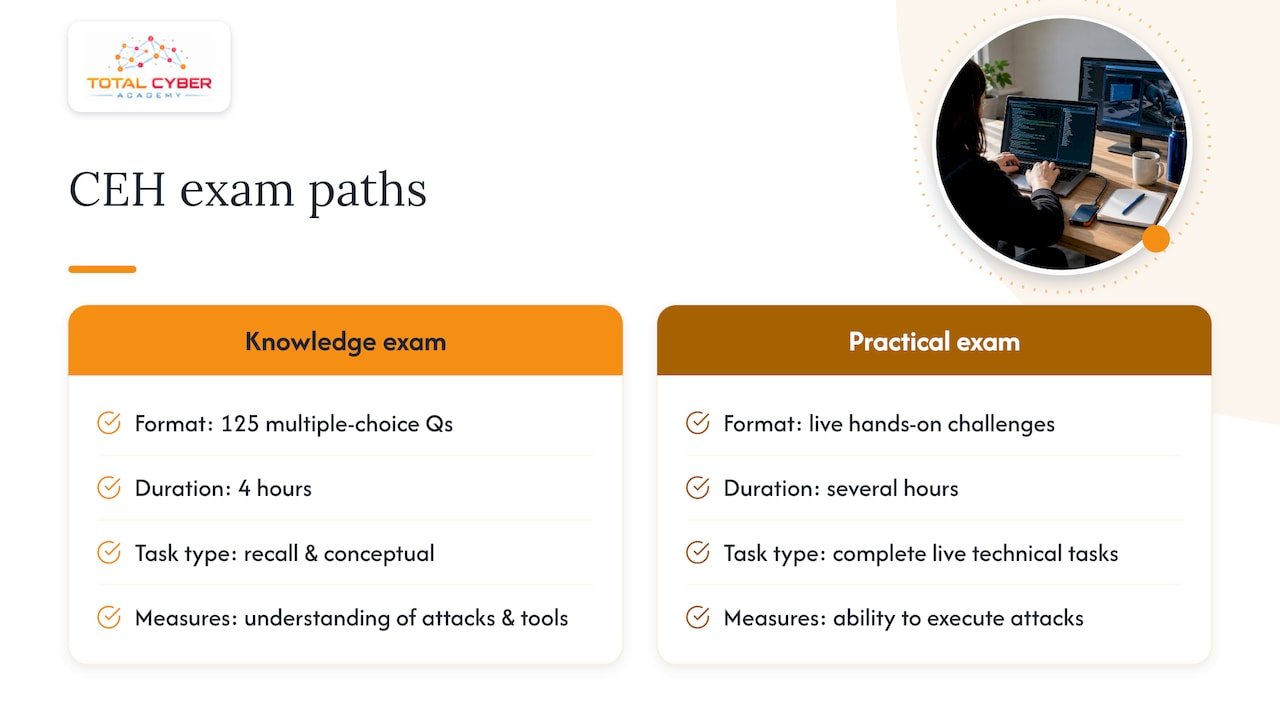
Passing the knowledge exam proves you understand how attacks work and what tools exist for each stage. It does not prove you can chain an exploit together under pressure, write a clean penetration test report, or improvise when a target behaves unexpectedly. That gap matters once you are sitting across from a hiring manager who wants evidence, not vocabulary.
Benefits and Limitations of CEH for Job Seekers
CEH earns its keep mostly on the HR side of hiring. Applicant tracking systems and recruiters who do not have a technical background often use it as a filter, and some job postings in government and defense-adjacent roles name it explicitly because of its DoD 8140 mapping.
Where it falls short is with the people who make the final hiring call on technical teams, who often rely on specialized cybersecurity services to assess candidates’ practical skills. Pen-test leads and security engineers tend to look past the certification line and ask for evidence, which is why many candidates pair CEH with hands-on penetration testing certifications or a documented project history.
- CEH helps you clear automated screening and some government-adjacent job filters.
- Technical hiring managers usually still want labs, CTFs, or a portfolio as proof of skill.
- The credential moves the needle most when an employer funds it or a posting names it directly; current prices and options are available on our website.
Cost, Time, and Maintenance You Should Budget For
The exam voucher for CEH commonly runs around $1,199 for non-members, according to CLIMB’s cost breakdown, and that figure sits before any official training, which adds a meaningful amount on top. Self-study with third-party materials and labs can cut that incremental cost, but it extends your prep timeline and shifts more of the hands-on gap onto you.
Study time varies by background. Someone with a few years of IT experience might need 60 to 80 hours for the knowledge exam alone; the practical option demands real lab repetition, not just reading.
- Knowledge exam prep: commonly 6 to 10 weeks of part-time study.
- Practical exam prep: additional lab hours focused on execution, not memorization.
- Renewal: CEH certifications run on a three-year cycle with continuing-education credit requirements to maintain, a heavier credit load than some competing certifications.
For a full breakdown of voucher pricing and budget scenarios, see our CEH exam cost guide.
Who Should Get CEH: A Decision Checklist
Run your situation against these criteria before committing to a voucher.
- Prior IT experience: if you have under two years in IT or security, CEH gives you a structured vocabulary foundation worth having.
- Target role: check whether the job descriptions you want actually list CEH, or whether they ask for OSCP, PenTest+, or demonstrated lab work instead.
- Employer funding: if your employer covers the voucher and training, the cost objection mostly disappears.
- DoD or contractor requirements: confirm your specific billet against the DoD 8140 matrix rather than assuming CEH qualifies.
- Hands-on portfolio status: if you already have CTF placements, home lab writeups, or real pen-test experience, CEH adds less marginal value.
Red flags that point you elsewhere: you already have strong technical proof and are targeting senior penetration testing roles, or your budget is tight and no employer funding is available. In those cases, a hands-on credential or a portfolio-building push may return more per dollar than another knowledge exam.
Pro Tip: Before you buy a voucher, search three job postings for your target title and note whether CEH, OSCP, or “equivalent experience” shows up most.
If the checklist points toward “yes,” review our entry-level cybersecurity jobs guide to map out realistic first roles.
Career Impact and Salary Context
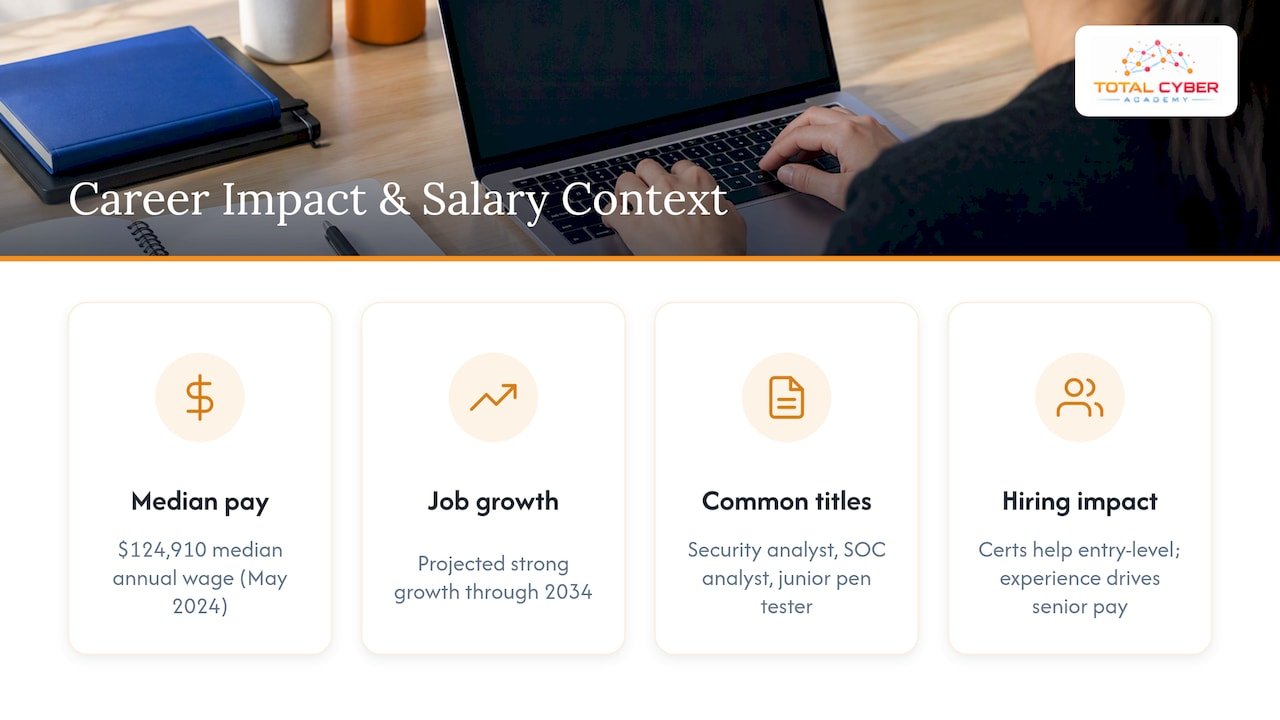
Information security analysts earned a median annual wage of about $124,910 in May 2024, with the Bureau of Labor Statistics projecting significant employment growth and many new positions through 2034. That growth rate is well above most occupations, which is the strongest argument for entering the field at all, certification choice aside.
CEH tends to show up most in job titles like security analyst, SOC analyst, and junior penetration tester, often listed as “preferred” rather than “required.” Certifications influence hiring mainly at the entry level, where they substitute for experience you do not yet have. At senior levels, employers weigh experience and demonstrated results far more heavily, and no single certification, CEH included, guarantees top-tier pay on its own. Combining a certification with real project work or prior IT experience tends to move compensation more than the certification alone.
DoD, Government, and Contractor Relevance
If you are eyeing a Department of Defense or contractor role, do not assume CEH qualifies just because it is widely recognized. The DoD 8140 qualification matrix is the authoritative document mapping commercial certifications to specific cyber work roles, and it gets updated periodically through change bulletins.
Check the matrix directly for the work role code tied to your target billet, then confirm with the hiring component, since requirements can vary by service branch. Watch for two common pitfalls: assuming an older matrix version still applies, and missing component-specific grandfathering rules that let existing staff keep a role without the newly required certification. Our DoD 8570 certifications guide walks through related verification steps.
Training and Preparation Options Worth Comparing
You have several paths into CEH, and they are not mutually exclusive. Official EC-Council training gives you structured content and exam alignment. Bootcamps compress the timeline but demand more hours per week. Self-study paired with labs costs less upfront but puts the burden of structure on you.
Whichever path you choose, pair it with hands-on work: CTF competitions, a home lab, or a documented project log that shows what you actually built or broke. That portfolio is what fills the gap the knowledge exam leaves open.
- Official training gives structure and exam alignment but costs more upfront.
- Self-study plus labs costs less but takes more discipline to finish.
- CTFs and portfolio projects are what technical interviewers ask about most.
We cover CEH on-demand, the live CEH course, and how they compare to other study paths in our CEH training programs guide.
Who I See Getting the Most Out of CEH
The clearest winners are career changers with employer-funded training, early-career analysts who need a credential to clear automated screens, and anyone targeting a role that names CEH outright. If none of those apply, hands-on proof will likely serve you better than another exam voucher.
Check your target job listings, confirm any DoD requirement against the matrix, and only then decide whether to enroll.
— Alden
How We Help You Prepare for CEH
We built our EC-Council CEH On-Demand Course and live CEH course around hands-on labs and instructor access, not just slide decks, because passing the exam and proving you can do the work are different problems. Our instructors are working cybersecurity professionals, and we structure mentorship around closing the gap between CEH’s concepts and the practical skills hiring managers ask about.
- The CEH On-Demand course provides self-paced access to labs and exam preparation.
- The live CEH course includes instructor sessions and mentorship.
- Flexible scheduling options are available to accommodate different learners’ needs.
Browse our full course catalog to compare CEH against our other certification and program tracks.
FAQ
Is 40 Too Late for a Cybersecurity Career?
No. Cybersecurity hiring leans on demonstrated skills and certifications more than age, and the field’s projected 29% job growth through 2034 reflects strong demand for new entrants at any career stage, according to the Bureau of Labor Statistics. Prior IT, military, or analytical experience often transfers well into entry-level security roles.
Can CEH Get You a Job?
CEH can help you clear HR screening and automated filters, and it appears in some job postings tied to DoD 8140 work roles. On its own, it rarely secures a technical role without accompanying hands-on proof like labs or project work.
Is CEH Easy to Pass?
Difficulty depends on your background and prep path; the knowledge exam is 125 multiple-choice questions over four hours, while the practical option adds live, hands-on challenges that are harder to pass without lab practice, according to CLIMB’s certification breakdown. Candidates with prior IT or security exposure generally find the knowledge exam more manageable than the practical track.
What Is the CEH Salary Range?
CEH itself does not set a salary, but it commonly appears in roles like security analyst and junior penetration tester. The broader information security analyst occupation reported a median annual wage of $124,910 in May 2024, according to the Bureau of Labor Statistics.
How Much Does the CEH Exam Cost?
The CEH exam voucher commonly runs around $1,199 for non-members, according to CLIMB’s cost analysis, with official training adding further cost on top of the voucher itself. Our CEH exam cost guide breaks down budget scenarios in more detail.
Sources
- Information Security Analysts : Occupational Outlook Handbook : U.S. Bureau of Labor Statistics
- DoD 8140 Cyber Workforce Qualification Program Qualification Matrix (SOP)
- What Is CEH Certification and Is It Worth It? – CLIMB