
Most cybersecurity bootcamps take roughly three to six months. One widely cited guide puts the range at 12 to 26 weeks, with full-time programs finishing sooner and part-time programs taking longer. The calendar length alone tells you very little, though. What matters is how many total hours the program contains, how many of those hours you can give each week, and what you still need to do after the last class: sit for a certification exam and find a first role.
This guide explains how to read a bootcamp’s length, how to turn it into a schedule you can actually keep, and how U.S. education-benefit rules can change the timeline for veterans.
TL;DR
- Expect about 12 to 26 weeks for a typical cybersecurity bootcamp. Full-time formats sit at the short end, part-time formats at the long end.
- Total program hours divided by the hours you can study each week gives your real finish date. Ask for both numbers before you enroll.
- Prior IT experience, prerequisites and certification exam preparation are the usual reasons a program runs longer than advertised.
- Finishing coursework is not the same as being job-ready. Plan extra weeks for the exam and for the job search.
- Veterans using the Post-9/11 GI Bill should check how VA measures pursuit of a program, because weekly hours can affect payments.
Table of Contents
- How long a cybersecurity bootcamp usually takes
- Full-time, part-time and self-paced schedules compared
- Hours per week: doing the math yourself
- What makes a bootcamp take longer than advertised
- Finishing coursework versus becoming job-ready
- Planning a bootcamp around service, work and family
- Our perspective: length is the wrong first question
- Training options that fit different schedules
- FAQ
- Sources
How long a cybersecurity bootcamp usually takes
The published range for U.S. cybersecurity bootcamps runs from about 12 to 26 weeks, according to a guide from a education-finance company. That is the figure you will see most often in search results, and it matches what most readers find when they compare programs: a few months of intensive study, not a few weeks and not several years.
Three things explain the spread inside that range:
- Schedule intensity. A full-time program with classes every weekday compresses the same material into fewer calendar weeks than an evening or weekend program.
- Scope. A program that prepares you for one entry-level certification is shorter than one that covers networking, security operations, and offensive skills together.
- Starting point. A program built for beginners spends time on fundamentals that an experienced help desk technician can skip.
Treat any single number, including the one above, as a starting estimate. The only length that counts is the one in the syllabus of the specific program you are considering, expressed in total hours.
Full-time, part-time and self-paced schedules compared
The same curriculum can take very different amounts of calendar time depending on the delivery format. The table below describes the general pattern. Exact weeks vary by provider, so use it to compare formats, not to predict a specific program.
| Format | Typical weekly commitment | Calendar length | Best fit |
|---|---|---|---|
| Full-time, instructor-led | Close to a full work week | Shortest, often the low end of the 12 to 26 week range | People between jobs, recently separated service members, anyone who can step away from work |
| Part-time, instructor-led (evenings or weekends) | Several hours per class night plus homework | Longer, often toward the high end of the range | Working adults and parents who need a fixed schedule and live instruction |
| Self-paced or on-demand | Whatever you choose | Open-ended, set by your discipline | Self-directed learners with irregular schedules, such as shift workers |
Two cautions apply. First, self-paced does not mean faster. Without a class calendar, many learners drift, and a course that could take two months stretches to six. Second, part-time does not mean easier. It means the same workload spread over more weeks, which tests your stamina rather than your schedule.
Hours per week: doing the math yourself
Because providers describe programs in different ways (weeks, months, or hours), convert everything to total hours and weekly hours. The arithmetic is simple. The example below uses a hypothetical program of 300 total hours, including labs, lectures and homework:
- At 40 hours per week: 300 / 40 = 7.5 weeks.
- At 20 hours per week: 300 / 20 = 15 weeks.
- At 15 hours per week: 300 / 15 = 20 weeks.
- At 10 hours per week: 300 / 10 = 30 weeks.
Notice that the 15 to 20 week outcomes sit inside the commonly quoted 12 to 26 week range, and that dropping to 10 hours a week pushes the same program past it. That is why a part-time schedule that looks light on paper can quietly become a seven-month commitment.
When you talk to an admissions team, ask these questions:
- How many total hours does the program include, and how many of them are live instruction versus self-study?
- How many hours of homework and lab practice should I expect each week outside class?
- Are labs available around the clock, or only during class sessions?
- What happens if I miss a week? Can I join a later cohort or watch recordings?
If a provider cannot answer the first question with a number, treat that as a warning about how well the program is planned.
What makes a bootcamp take longer than advertised
Advertised length usually assumes an ideal student. Real timelines stretch for predictable reasons.
Prerequisites and prior experience
Cybersecurity builds on networking, operating systems and basic troubleshooting. If you have not worked with those, you may need foundational study first. Our cybersecurity training prerequisites checklist lays out what to have in place so you are not learning basics and advanced material at the same time. Learners with help desk or networking backgrounds often move through early modules faster and spend their time on the harder topics.
Certification preparation
Most entry-level bootcamps are built around an industry certification, commonly CompTIA Security+ for newcomers. Finishing the lectures does not mean you are exam-ready. Plan for practice exams, review of weak domains, and time to schedule and sit the test. Many learners add several weeks of focused review after class ends, particularly if they work full time.
Hands-on labs
Labs are where skill is built, and they take longer than watching a video. A program with extensive lab work will cost more weekly hours than one that is mostly lecture. That time is well spent: employers hiring for technical roles want to know you can do the work, not only that you passed a test. For a closer look at how lab time is structured, see our guide to what hands-on cybersecurity training involves.
Life
A deployment, a move, a night-shift rotation, a sick child. Part-time learners especially should build slack into the plan. A schedule with no buffer is a schedule that breaks in week eight.
Finishing coursework versus becoming job-ready
The end of a bootcamp is not the end of the process. Think of three separate clocks:
- Coursework. The 12 to 26 weeks (or whatever your program lists) of instruction, labs and assignments.
- Certification. Practice exams, review and the exam itself, which often follows the last class by a few weeks.
- Job search. Resume work, interview practice and applications, which can take months and depends heavily on the local market and your background.
No reputable provider can promise a start date for your first job, and you should be cautious of any that does. What you can control is how ready you are when you start applying: a certification, a portfolio of lab work you can describe, and a resume that translates your experience. Our career prep course and LinkedIn Ready pages cover that final stretch.
For a realistic view of whether the time and money pay off, our guide on whether a cybersecurity bootcamp is worth it works through the weekly time commitment for career changers and veterans, and the bootcamp cost guide covers tuition and hidden fees.
Planning a bootcamp around service, work and family
Veterans, Guard and Reserve members and military spouses often study around obligations that civilian learners do not have. A few principles help.
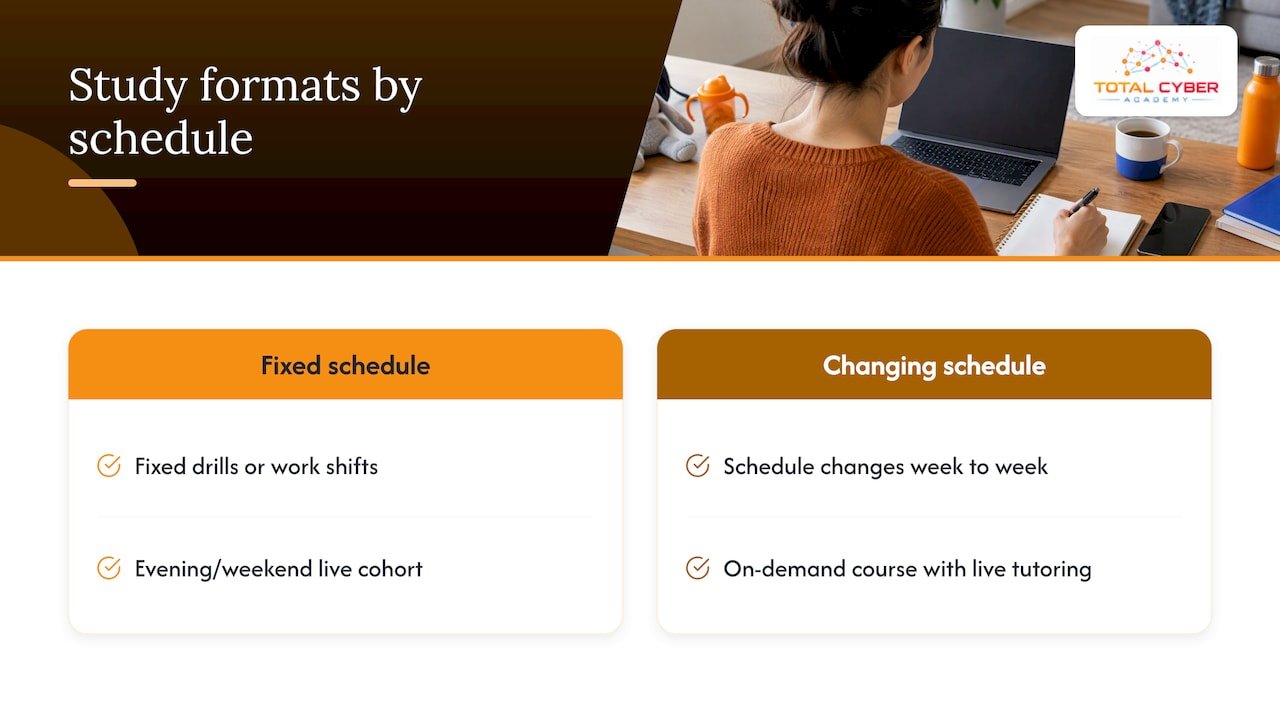
Pick the format before the program. If your drill weekends or work shifts are fixed, an evening or weekend cohort with live instruction gives structure. If your schedule changes week to week, an on-demand course with live tutoring support is more forgiving.
Protect a fixed study block. A consistent block, such as the same three evenings and one weekend morning, beats an ambitious plan that depends on free time appearing.
Count the full path. Add coursework, exam preparation and a job-search buffer, then check whether that total fits before your benefits, transition leave or savings run out.
How GI Bill rules can affect your schedule
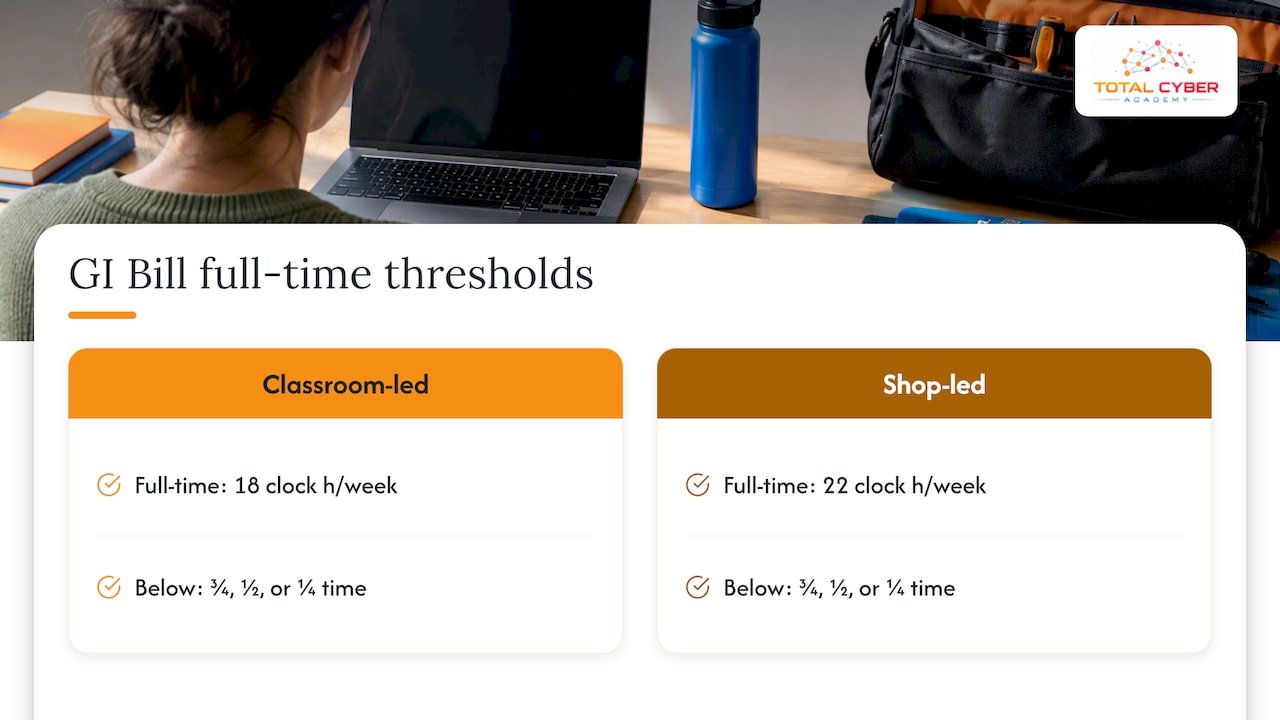
If you plan to use the Post-9/11 GI Bill, weekly hours matter beyond your own time management. VA bases the rate of pursuit on the credits you take each term or the clock hours you are scheduled to attend each week. For non-college degree programs measured in clock hours, VA’s full-time-equivalency guidance says full-time is 18 clock hours per week when classroom instruction predominates and 22 when shop practice predominates, with lower weekly hours counting as three-quarter, half or quarter time.
In practice, a lighter weekly schedule can mean a lower rate of pursuit, which can change what you receive. For non-college degree programs, the Post-9/11 GI Bill tuition and fees payment is capped at $30,908.34 for the August 1, 2026 to July 31, 2027 benefit year. These figures are updated each August, so confirm the current ones on the VA page.
Whether a given program is approved for GI Bill payment is a separate question that only VA and the school can answer. Before you enroll, ask the school how its program is approved and measured, and speak with a VA education counselor or your school certifying official about how your weekly schedule would be treated. Our GI Bill cybersecurity training guide walks through the questions to ask, and the SkillBridge explainer is the place to start if you are still on active duty and want to train before you separate. For a month-by-month view, see our veteran roadmap with the GI Bill.
Our perspective: length is the wrong first question
We hear “how long is it?” from nearly every prospective student, and we understand why. Time is the scarce resource, especially for veterans balancing a job, a family and the transition out of service. But after working with beginners, career changers and IT professionals, we think the better first question is what you will be able to do when the program ends.
A short program that teaches you to pass one exam can leave you unable to answer a basic technical question in an interview. A longer program built around practical labs, live tutoring and mentorship from working cybersecurity professionals tends to give you something employers can see. That is why we emphasize real-world skills above exam-only preparation, and why we offer extra instructor support rather than leaving students alone with recorded lectures.
Our advice for choosing a length is practical:
- Start from your honest weekly hours, not your most optimistic ones.
- Choose the format that you can sustain for the whole program, even if another looks faster on a brochure.
- Add time after the last class for the exam and the job search.
- Use certifications as milestones along a career path, not as the destination.
The students who finish are rarely the ones who found the shortest program. They are the ones who picked a schedule they could keep.
— Alden
Training options that fit different schedules
We offer several ways to match your calendar. Our on-demand and live certification courses cover CompTIA, EC-Council and ISC2 preparation. For example, the CompTIA Security+ 701 On-Demand Course is $2,499.99 one-time, and the CompTIA Security+ SY0-701 Live Course is $2,999.99 one-time. The EC-Council CEH On-Demand Course is $2,999.99 and the CEH Live Course is $3,499.99.
If you want a broader, career-focused path, our career programs include Cybersecurity Engineer, Penetration Tester, IT Operations Specialist and Cloud Engineer tracks. Program pricing is not published, so contact us for details and for how each is scheduled. Veterans can also read our cybersecurity training for veterans guide to see which paths move fastest.
FAQ
How long is a typical cybersecurity bootcamp?
Most programs run about 12 to 26 weeks, according to one U.S. guide. Full-time programs finish toward the short end, and part-time programs toward the long end. Always confirm the total hours and weekly commitment for the specific program.
Can I do a cybersecurity bootcamp while working full time?
Yes, many people do, usually through an evening, weekend or on-demand format. Expect the program to take more calendar weeks than a full-time version of the same curriculum. Build a fixed weekly study block and leave buffer weeks for work or family disruptions.
How long does it take to prepare for the Security+ exam after a bootcamp?
It depends on your weekly study time and prior experience. Many learners add a few weeks of practice exams and review after class ends, and beginners often need longer than people with IT backgrounds. Take practice tests under timed conditions and review the domains where you score lowest before booking the exam.
Does a shorter bootcamp mean I will get a job faster?
Not necessarily. Program length measures instruction time, not hiring timelines, which depend on your skills, certifications, portfolio and local market. A program with strong labs and mentoring can prepare you better than a quick, exam-only course.
Sources
- Are Cybersecurity Bootcamps Worth It? A Guide (Ascent Funding)
- Post-9/11 GI Bill Rates (U.S. Department of Veterans Affairs)
- Full-time Equivalency (FTE), Education and Training (U.S. Department of Veterans Affairs)